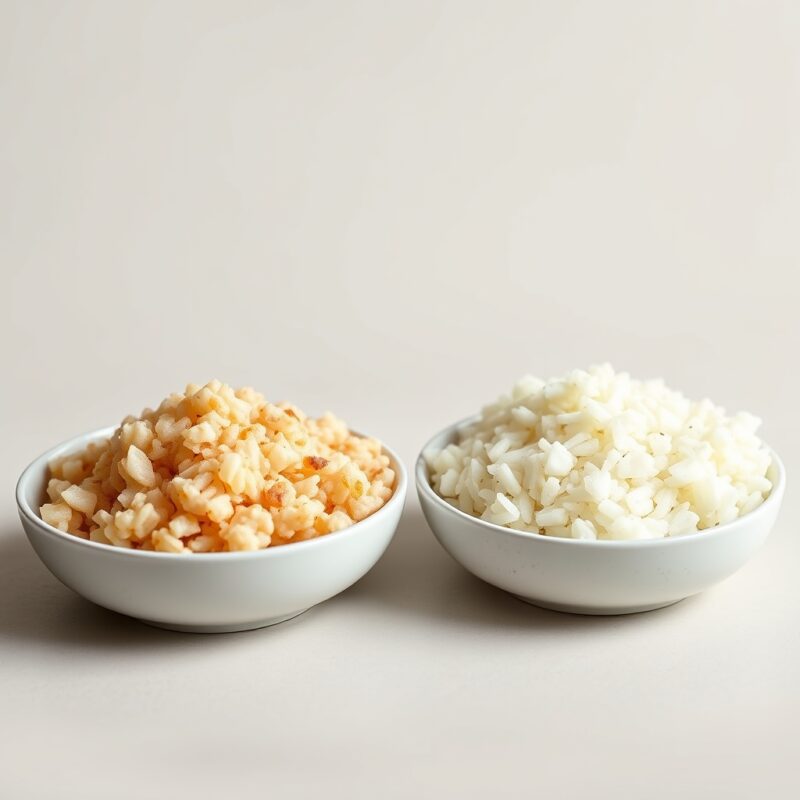
Raw rice and cooked rice display dramatically different nutrition facts because cooking adds water weight without adding calories, protein, or most other nutrients. One cup of raw long-grain white rice (185 g) contains approximately 675 calories, 13 g protein, and 148 g carbohydrate, while one cup of cooked white rice (158 g) contains roughly 205 calories, 4.2 g protein, and 45 g carbohydrate. The nutrient density per gram drops by about 70% after cooking due to water absorption. This difference means you cannot directly compare raw and cooked rice nutrition labels without adjusting for the water content and yield ratio, which typically ranges from 1:2.5 to 1:3 depending on rice variety and cooking method.
Why Raw and Cooked Rice Nutrition Facts Differ
Rice grains absorb water during cooking, which increases total weight and volume without adding macronutrients or most minerals. The starch granules in raw rice swell as they hydrate, and the final cooked weight depends on the water-to-rice ratio, cooking time, and whether excess water is drained. White rice, brown rice, jasmine, basmati, and other varieties all follow this pattern, though the exact yield ratio varies by grain length, processing, and cooking method.
When you read a nutrition label on a package of raw rice, the serving size is typically listed as a dry measurement—often ¼ cup or 45 g uncooked. The corresponding cooked yield may appear in parentheses, such as “makes about 1 cup cooked.” If you measure cooked rice directly, the same volume contains far fewer calories and less protein per gram because water now makes up 60–70% of the total weight.
Water Absorption and Yield Ratios
The yield ratio describes how much cooked rice you obtain from a given amount of raw rice. For most long-grain white rice, the ratio is approximately 1:3 by volume or 1:2.5 by weight. Medium-grain and short-grain varieties may absorb slightly more water, while brown rice often requires a longer cooking time and may yield a ratio closer to 1:2.5 by volume. Parboiled rice and instant rice have been pre-treated and may absorb water more quickly, but the final cooked weight still reflects significant water content.
If you cook 1 cup (185 g) of raw white rice with 2 cups of water and allow it to simmer until absorbed, you will typically end up with about 3 cups (approximately 555 g) of cooked rice. The calorie content remains nearly the same—around 675 calories total—but it is now distributed across three times the volume. This is why one cup of cooked rice contains roughly one-third the calories of one cup of raw rice.
Per-100 g Comparison: Raw vs Cooked White Rice
Comparing raw and cooked rice on a per-100 g basis removes the confusion introduced by volume measurements. Raw long-grain white rice contains approximately 365 calories, 7 g protein, 80 g carbohydrate, and 0.6 g fat per 100 g. Cooked long-grain white rice prepared without added fat or salt contains approximately 130 calories, 2.7 g protein, 28 g carbohydrate, and 0.3 g fat per 100 g. The reduction reflects the dilution effect of water, not a loss of nutrients.
Micronutrients such as iron, thiamin, and folate are also diluted by water weight, though some water-soluble vitamins may leach into cooking water if you use the excess-water method and then drain the rice. Minerals like magnesium and phosphorus remain largely intact, but their concentration per 100 g drops proportionally to the water absorbed.
Common Mistakes When Comparing Raw and Cooked Rice
One frequent error is assuming that a nutrition database entry labeled “rice” without a preparation qualifier refers to cooked rice. Many databases default to raw values unless otherwise specified, which can lead to significant overestimation of calorie and protein intake if you measure cooked portions. Always confirm whether the entry states “raw,” “cooked,” “boiled,” or “steamed.”
Another mistake is using volume measurements interchangeably. One cup of raw rice is not equivalent to one cup of cooked rice in nutrient content. If a recipe calls for one cup of cooked rice and you substitute one cup of raw rice, you will triple the calorie and carbohydrate load. Conversely, if you log one cup of raw rice in a food diary but actually consumed one cup of cooked rice, you will overestimate your intake by roughly 200%.
Draining excess water after cooking can also affect the final nutrient profile. Some cooking methods involve boiling rice in a large volume of water and then draining it, similar to pasta. This technique may remove a small percentage of water-soluble B vitamins and trace minerals, though the effect is generally modest for rice compared to other grains.
Brown Rice and Other Varieties
Brown rice retains the bran and germ layers, which contribute additional fiber, magnesium, and B vitamins compared to white rice. Raw long-grain brown rice contains approximately 370 calories, 7.9 g protein, 77 g carbohydrate, and 2.9 g fat per 100 g. Cooked brown rice prepared without added ingredients contains roughly 112 calories, 2.6 g protein, 23 g carbohydrate, and 0.9 g fat per 100 g. The yield ratio for brown rice is often closer to 1:2.5 by volume because the bran layer absorbs water more slowly.
Specialty varieties such as jasmine, basmati, black, and red rice follow similar water-absorption patterns. Aromatic varieties may have slightly different starch compositions, but the fundamental principle remains: cooking adds water weight, which dilutes nutrient density per gram without removing the original nutrients.
When to Use the Nutrition Lookup Tool
If you need source-linked data for a specific rice variety or preparation method, the Nutrition Lookup tool connects you to FDC records that specify whether values are for raw or cooked rice. This is especially useful when you are comparing enriched white rice, which has added thiamin, niacin, and iron, to unenriched or whole-grain varieties. The tool also clarifies whether a database entry includes added salt, oil, or other ingredients that may appear in pre-seasoned or restaurant-prepared rice.
For broader context on how different cooking methods affect nutrient retention and bioavailability, see How Cooking Changes Nutrition Facts. That resource explains the mechanisms behind water absorption, heat-induced vitamin loss, and the impact of cooking time and temperature across multiple food categories.
Practical Checklist for Accurate Comparison
- Check the preparation state: Confirm whether the nutrition label or database entry specifies “raw,” “dry,” “cooked,” “boiled,” or “steamed.”
- Use weight, not volume: Measure rice in grams when possible, especially if you are tracking intake for meal planning or dietary analysis.
- Calculate yield: If you start with a known weight of raw rice, multiply by 2.5–3 to estimate the cooked weight for white rice, or by 2.5 for brown rice.
- Account for added ingredients: Butter, oil, salt, or broth added during cooking will increase the calorie, fat, and sodium content beyond the base grain values.
- Verify database defaults: Many nutrition apps default to raw values unless you explicitly select a cooked entry. Double-check the serving size and preparation method.
Label Reading and Serving Size Context
Packaged rice labels in the United States typically list nutrition facts for a dry serving size, such as ¼ cup (45 g) uncooked, with a note indicating the approximate cooked yield. The %Daily Value figures on the label apply to the dry serving, not the cooked portion. If you consume one cup of cooked rice, you are eating roughly one-third of the dry serving listed on the package, so you would divide the %DV figures by three to estimate your actual intake from that cooked cup.
For more detail on interpreting raw versus cooked values across different food groups, visit the Raw vs Cooked Nutrition overview. Additional preparation-impact articles are available in the Preparation Impact category, which covers grains, legumes, vegetables, and proteins.
Frequently Asked Questions
Does cooking rice destroy protein or carbohydrates?
No. Cooking rice does not destroy protein or carbohydrates. The total amount of these macronutrients remains nearly constant; the apparent reduction per gram or per cup is due to water absorption, which increases total weight and dilutes nutrient concentration.
Can I use raw rice nutrition facts if I only have cooked rice?
You should not use raw rice values directly for cooked rice. Instead, divide the raw values by the yield ratio—typically 2.5 to 3 for white rice—to estimate the cooked values, or search for a database entry explicitly labeled as cooked.
Why do some databases show different calorie counts for cooked rice?
Calorie counts for cooked rice vary because the final water content depends on the cooking method, water-to-rice ratio, and whether excess water was drained. Entries that specify “boiled, drained” may show slightly lower values than “steamed” or “absorption method” entries.
Does rinsing rice before cooking affect nutrition facts?
Rinsing raw rice removes surface starch and a small amount of water-soluble vitamins, but the effect on overall nutrition facts is minimal. Enriched white rice may lose a trace of added thiamin or niacin if rinsed extensively, though the loss is generally less than 5%.
How do I log rice accurately in a food diary?
Weigh your cooked rice in grams and select a database entry that explicitly states “cooked” or “boiled.” If you only have a raw entry, divide the raw values by your known yield ratio, or use the cooked weight and search for a matching cooked entry.
Is the fiber content the same in raw and cooked rice?
The total grams of fiber remain the same, but the fiber content per 100 g of cooked rice is lower than per 100 g of raw rice because of water dilution. For example, raw brown rice may contain 3.5 g fiber per 100 g, while cooked brown rice contains roughly 1.8 g per 100 g.
Sources and Methodology
Nutrient values for raw and cooked rice are drawn from the USDA FoodData Central database, which provides separate entries for raw, cooked, enriched, and unenriched varieties. Yield ratios are based on standard cooking methods described in USDA guidelines and culinary references. Water absorption and nutrient dilution calculations follow established food-science principles documented in peer-reviewed literature on cereal grains. For transparency on how eNutritionFacts sources and verifies data, see the Data Methodology page.
Educational Disclaimer
This content is for educational purposes and does not constitute medical or dietary advice. Individual nutrient needs vary based on age, activity level, health status, and other factors. If you have specific dietary requirements, food allergies, or medical conditions that affect carbohydrate or calorie intake, consult a registered dietitian or qualified healthcare provider. For full terms, see the Medical Disclaimer.