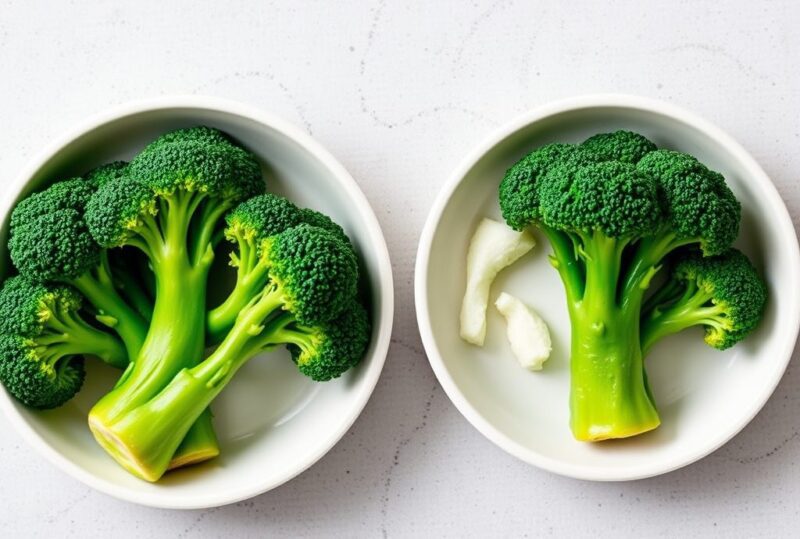
Steamed broccoli typically retains more vitamin C and folate than boiled broccoli because water-soluble nutrients leach into boiling water, especially during longer cooking times. Steaming exposes broccoli to less water and often requires shorter cooking durations, which helps preserve heat-sensitive vitamins. However, both methods reduce raw broccoli’s volume through moisture loss, concentrating certain nutrients per 100 grams of cooked weight. The actual difference depends on cooking time, water volume, whether you consume the cooking liquid, and the specific nutrient you’re tracking. Macronutrients—protein, carbohydrate, fiber, and fat—remain relatively stable across both methods, while micronutrient retention varies. If you drain boiled broccoli and discard the water, you lose more water-soluble vitamins than if you steam it briefly or use the cooking liquid in soups or sauces.
What Steamed and Boiled Broccoli Mean on Nutrition Labels
When a nutrition label or database entry specifies “steamed” or “boiled,” it describes the cooking method applied to raw broccoli florets and stems. Steaming suspends broccoli above simmering water, cooking it with steam heat. Boiling submerges broccoli directly in water at or near 100°C (212°F). Both methods soften cell walls, making broccoli easier to chew and digest, but they differ in water exposure and typical cooking duration. Standard USDA FoodData Central entries for “Broccoli, cooked, boiled, drained, without salt” and “Broccoli, cooked, steamed, without salt” reflect these preparation differences. The “drained” qualifier for boiled broccoli indicates that cooking water was discarded, which is the most common home practice.
Nutrition facts for cooked broccoli are usually reported per 100 grams of edible cooked weight or per standard serving (often 1 cup chopped, approximately 156 grams cooked). Because cooking reduces water content and shrinks volume, 100 grams of cooked broccoli represents more raw broccoli than 100 grams of raw florets. This concentration effect can make some nutrients appear higher per gram in cooked broccoli, even if absolute amounts decline during cooking. Understanding whether a label shows per-100-gram or per-serving values is essential when comparing steamed and boiled entries. For a broader explanation of how preparation alters nutrient density, see our guide on raw vs cooked nutrition.
Macronutrient and Fiber Comparison
Steamed and boiled broccoli show nearly identical macronutrient profiles per 100 grams of cooked weight. Both methods yield approximately 2.4–2.8 grams of protein, 6–7 grams of total carbohydrate, and 2.6–3.3 grams of dietary fiber per 100 grams. Fat content remains minimal, around 0.3–0.4 grams. Total energy ranges from 30 to 35 kilocalories per 100 grams, depending on the specific cultivar and cooking duration. These macronutrients are stable during brief heat exposure because proteins, starches, and fiber structures do not dissolve significantly into cooking water within typical home cooking times of 3–7 minutes.
Fiber, composed largely of cellulose and hemicellulose, softens during cooking but does not leach into water. Steaming and boiling both break down some cell-wall polysaccharides, which can improve digestibility and increase the bioavailability of certain phytonutrients trapped in raw cell walls. If you are tracking macronutrients for meal planning or calorie control, either method provides equivalent amounts per serving, assuming similar starting weights and cooking times.
Vitamin C Retention: The Key Difference
Vitamin C (ascorbic acid) is the nutrient most affected by the choice between steaming and boiling. Raw broccoli contains approximately 89 milligrams of vitamin C per 100 grams. Steamed broccoli typically retains 60–80 milligrams per 100 grams, while boiled and drained broccoli may drop to 40–65 milligrams per 100 grams, depending on cooking time and water volume. Vitamin C is both heat-sensitive and water-soluble, so prolonged boiling in large volumes of water accelerates leaching and oxidative degradation.
Steaming limits water contact and often requires shorter cooking times—usually 4–5 minutes to achieve tender-crisp texture—compared to boiling, which may take 5–7 minutes in vigorously bubbling water. Shorter exposure to heat and minimal water immersion reduce vitamin C losses. If you consume the cooking liquid from boiled broccoli—for example, by using it as a soup base—you recapture some of the leached ascorbic acid, narrowing the gap between steamed and boiled retention. For additional context on how cooking methods alter nutrient profiles, visit our how cooking changes nutrition facts overview.
Folate and B-Vitamin Considerations
Folate, another water-soluble B-vitamin, follows a similar pattern to vitamin C. Raw broccoli provides roughly 63 micrograms of folate per 100 grams. Steamed broccoli retains approximately 50–55 micrograms, while boiled and drained broccoli may fall to 40–50 micrograms per 100 grams. The difference arises because folate leaches into boiling water and is partially degraded by prolonged heat. Steaming’s shorter cooking time and reduced water contact help preserve more folate.
Other B-vitamins—thiamin (B1), riboflavin (B2), niacin (B3), and vitamin B6—are also water-soluble but generally more heat-stable than vitamin C. Losses during steaming and boiling are modest, typically 10–20 percent, and the difference between the two methods is smaller than for vitamin C or folate. If B-vitamin intake is a priority, both steaming and boiling provide reasonable retention, especially if cooking times are kept under 7 minutes.
Vitamin K, Vitamin A, and Fat-Soluble Nutrients
Vitamin K and provitamin A carotenoids (beta-carotene) are fat-soluble and do not leach significantly into cooking water. Both steamed and boiled broccoli retain similar amounts of these nutrients per 100 grams of cooked weight. Raw broccoli contains approximately 101 micrograms of vitamin K per 100 grams; cooked broccoli—whether steamed or boiled—typically shows 140–150 micrograms per 100 grams due to moisture loss and concentration. Beta-carotene, which the body converts to vitamin A, also concentrates slightly during cooking, and brief heat exposure may improve its bioavailability by breaking down cell walls.
Because these vitamins are not water-soluble, the choice between steaming and boiling has minimal impact on their retention. If you are prioritizing vitamin K or vitamin A intake, either method is suitable, and adding a small amount of fat—such as olive oil or butter—after cooking can enhance absorption of these fat-soluble compounds.
Mineral Retention: Potassium, Calcium, and Iron
Minerals such as potassium, calcium, magnesium, and iron are not destroyed by heat, but they can leach into cooking water if broccoli is boiled. Potassium, the most abundant mineral in broccoli, may decrease by 10–15 percent in boiled, drained broccoli compared to steamed broccoli. Raw broccoli contains approximately 316 milligrams of potassium per 100 grams; steamed broccoli retains around 290–300 milligrams, while boiled broccoli may drop to 270–290 milligrams per 100 grams.
Calcium and iron losses are smaller because broccoli contains modest amounts of these minerals to begin with. If you consume the cooking liquid, you recapture leached minerals, making boiling nearly equivalent to steaming in terms of total mineral intake. For readers tracking mineral content across multiple foods, our Nutrition Lookup tool provides source-linked FoodData Central records for both steamed and boiled broccoli entries.
Glucosinolates and Myrosinase Activity
Broccoli contains glucosinolates, sulfur-containing compounds that are hydrolyzed by the enzyme myrosinase into bioactive isothiocyanates, including sulforaphane. Myrosinase is heat-sensitive and begins to degrade at temperatures above 60°C (140°F). Both steaming and boiling reduce myrosinase activity, but steaming for 3–4 minutes typically preserves more enzyme activity than boiling for 5–7 minutes. Some research suggests that lightly steamed broccoli retains higher potential for sulforaphane formation compared to heavily boiled broccoli.
However, human gut bacteria also produce myrosinase, so even if cooking inactivates the plant enzyme, some glucosinolate conversion can still occur during digestion. If you are interested in maximizing glucosinolate-derived compounds, steaming for a shorter duration is preferable, but both methods allow partial retention. Adding raw broccoli sprouts or mustard powder—which contain active myrosinase—to cooked broccoli can also enhance isothiocyanate formation.
Water Volume, Cooking Time, and Draining Practices
The magnitude of nutrient loss during boiling depends on three variables: water volume, cooking time, and whether you drain or retain the cooking liquid. Boiling broccoli in a large pot of water for 7–10 minutes and then draining maximizes water-soluble nutrient losses. Boiling in minimal water for 4–5 minutes and using the liquid in a sauce or soup reduces losses significantly. Steaming inherently uses less water and typically requires 3–5 minutes to achieve tender-crisp texture, which limits both heat exposure and leaching.
If you prefer boiled broccoli for texture or recipe requirements, consider using just enough water to cover the florets, reducing cooking time, and incorporating the cooking liquid into your meal. This approach narrows the nutritional gap between boiling and steaming. For a deeper exploration of how preparation variables affect nutrient retention, see our Preparation Impact category.
Per-100-Gram vs. Per-Serving Comparisons
Nutrition databases often report values per 100 grams of cooked weight, but home cooks typically measure servings by volume—such as 1 cup chopped. One cup of cooked broccoli weighs approximately 156 grams, so a per-cup serving contains roughly 1.5 times the nutrients listed per 100 grams. When comparing steamed and boiled broccoli, ensure you are using the same basis—either per 100 grams or per standard serving—to avoid misleading conclusions.
Because both methods reduce water content, cooked broccoli is denser than raw broccoli by volume. One cup of raw broccoli florets weighs about 91 grams, while one cup of cooked broccoli weighs 156 grams. This means a cup of cooked broccoli represents more raw broccoli and delivers more total nutrients per cup, even if some vitamins are lost during cooking. If you are tracking daily vitamin C or folate intake, per-serving comparisons are more practical than per-100-gram figures.
Common Comparison Mistakes
One frequent error is comparing raw broccoli per 100 grams to cooked broccoli per 100 grams without accounting for moisture loss. Cooking concentrates some nutrients, so cooked broccoli may show higher values for certain minerals and fat-soluble vitamins per 100 grams, even though absolute amounts decline. Another mistake is assuming that all water-soluble vitamins behave identically; vitamin C is far more sensitive to heat and water than niacin or riboflavin.
Readers also sometimes overlook the impact of draining. If you retain boiled broccoli’s cooking liquid, nutrient losses are much smaller than if you discard it. Finally, comparing steamed broccoli cooked for 3 minutes to boiled broccoli cooked for 10 minutes exaggerates the difference; similar cooking times yield more comparable results. Always check the preparation details in the database entry or recipe to ensure a fair comparison.
When to Use Nutrition Lookup
If you need precise, source-linked nutrient values for steamed or boiled broccoli, use our Nutrition Lookup tool to access FoodData Central records. Standard entries include “Broccoli, cooked, boiled, drained, without salt” (FDC ID 169967) and “Broccoli, cooked, steamed, without salt” (FDC ID 169968). These records provide laboratory-analyzed values for macronutrients, vitamins, and minerals per 100 grams of cooked weight, along with serving-size conversions.
Nutrition Lookup is especially useful when you are comparing multiple preparation methods, tracking micronutrient intake for meal planning, or verifying label claims on packaged steamed or boiled broccoli products. The tool displays FDC IDs and data sources, so you can confirm the preparation method and ensure the values match your cooking practice.
Practical Checklist for Maximizing Nutrient Retention
- Choose steaming for vitamin C and folate: Steam broccoli for 3–5 minutes to retain the highest levels of water-soluble vitamins.
- Limit water volume if boiling: Use just enough water to cover florets, and cook for no more than 5–6 minutes.
- Retain cooking liquid: If you boil broccoli, use the cooking water in soups, sauces, or grains to recapture leached nutrients.
- Avoid overcooking: Both steaming and boiling should stop when broccoli is tender-crisp; mushy texture indicates excessive nutrient loss.
- Add fat after cooking: Drizzle olive oil or add butter to enhance absorption of fat-soluble vitamins K and A.
- Compare per-serving values: Use per-cup or per-standard-serving data to match real-world portion sizes.
Frequently Asked Questions
Does steaming broccoli preserve more nutrients than boiling?
Yes, steaming typically preserves more vitamin C and folate than boiling because it limits water contact and often requires shorter cooking times. Macronutrients and fat-soluble vitamins remain similar between the two methods.
How much vitamin C is lost when boiling broccoli?
Boiling and draining broccoli can reduce vitamin C content by 30–50 percent compared to raw broccoli, depending on cooking time and water volume. Steaming usually results in 15–30 percent loss.
Can I recover nutrients lost during boiling?
Yes, if you consume the cooking liquid—for example, by using it in a soup or sauce—you recapture most water-soluble vitamins and minerals that leached into the water.
Is boiled broccoli less nutritious than raw broccoli?
Boiled broccoli retains most macronutrients, fiber, and fat-soluble vitamins but loses some vitamin C and folate. Cooking also improves digestibility and may enhance the bioavailability of certain phytonutrients, so the overall nutritional value depends on your priorities.
Does steaming or boiling affect broccoli’s fiber content?
No, both methods preserve dietary fiber. Fiber does not dissolve in water, so steamed and boiled broccoli provide similar amounts per 100 grams of cooked weight.
Which method is better for sulforaphane retention?
Steaming for 3–4 minutes preserves more myrosinase enzyme activity than boiling for 5–7 minutes, which may support higher sulforaphane formation. However, gut bacteria can also convert glucosinolates, so both methods allow partial retention.
How do I compare steamed and boiled broccoli on a nutrition label?
Check whether values are per 100 grams or per serving, confirm the cooking method and draining practice, and compare similar cooking times. Use FoodData Central entries or our Nutrition Lookup tool for source-linked data.
Does adding salt to boiling water affect nutrient retention?
Salt does not significantly affect vitamin or mineral retention during boiling. It may slightly raise the boiling point, but the impact on nutrient loss is negligible compared to cooking time and water volume.
Sources and Methodology
Nutrient values for steamed and boiled broccoli are drawn from USDA FoodData Central entries, including “Broccoli, cooked, boiled, drained, without salt” and “Broccoli, cooked, steamed, without salt.” These entries reflect laboratory-analyzed data for macronutrients, vitamins, and minerals per 100 grams of cooked weight. Cooking-method effects on vitamin C, folate, and glucosinolates are supported by peer-reviewed studies on vegetable preparation and nutrient retention. For detailed sourcing standards and database methodology, see our Data Methodology page.
Educational Disclaimer
This content is for educational purposes only and does not constitute medical or dietary advice. Nutrient retention during cooking varies with cultivar, cooking time, water volume, and individual preparation practices. If you have specific dietary requirements, food allergies, or medical conditions, consult a registered dietitian or healthcare provider before making significant changes to your diet. For our full disclaimer, visit our Medical Disclaimer page.