eNutritionFacts
  • Nutrition Database
    • Nutrition Lookup
    • Nutrition Label Guide
    • Food & Drink Nutrition Facts
      • Fruits
      • Vegetables
      • Grains & Legumes
      • Proteins & Meat
      • Dairy & Alternatives
      • Beverages
      • Oils, Sauces & Condiments
      • Snacks & Packaged Foods
    • Semantic Food Comparison Engine
    • Nutrient Ranking Tool
    • Nutrition Data Methodology
  • Nutrition Topics
    • Nutrition Label Guides
    • Clean Label & Ingredients
    • Preparation Impact
  • Editorial Standards
    • Our Story & Mission
    • Expert Team
    • Editorial Guidelines & Fact-Checking Policy
    • Nutrition Data Methodology
    • Expert Review Policy
    • Corrections & Update Policy
    • Advertising & Affiliate Disclosure
    • Medical Disclaimer
  • Tools
    • Core Tools
      • Nutrition Lookup
      • Food Comparison Engine
      • Recipe Nutrition Calculator
      • Serving Size & %DV Label Converter
    • Research & Interpretation Tools
      • Nutrient Ranking Tool
      • Preparation Impact Estimator
      • Bioavailability Context Explainer
      • Nutrient Interaction Graph Explorer
    • Planning & Synthesis Tools
      • Macro Target Estimator
      • Meal Synthesizer
      • Amino Acid Complementarity Estimator
    • Verification & Governance Tools
      • Nutrient Data Provenance
      • Nutrition Data Provenance Ledger
      • Research Contribution Portal
      • Nutrition datasets
      • Semantic Graph Engine
  • Contact
Recent Posts
  • Patron Silver Tequila Nutrition Facts
  • Bacardi Superior White Rum Nutrition Facts
  • Why Cooked Foods Can Show More Calories per 100g
  • Liquid IV Ingredients: What Makes It Different from Other Hydration Mixes?
  • Natural Flavors on Food Labels
  • How Protein Helps with Satiety
  • Protein Distribution Across the Day Explained
  • What Is Glycemic Response in Nutrition?
  • What Does Bioengineered Food Ingredients Mean?
  • What Does Acidity Regulator Mean on a Food Label?

Categories

  • Additives & Preservatives
  • Beverages
  • Blood Sugar & Glycemic Response
  • Boiled, Steamed & Roasted Foods
  • Claims & Marketing Terms
  • Clean Label & Ingredients
  • Dairy & Alternatives
  • Food & Drink Nutrition Facts
  • Fruits
  • Grains & Legumes
  • Ingredient List Basics
  • Metabolic Nutrition
  • Nutrition Label Guides
  • Oils, Sauces & Condiments
  • Preparation Impact
  • Protein, Satiety & Appetite
  • Proteins & Meat
  • Raw vs Cooked Nutrition
  • Snacks & Packaged Foods
  • Sweeteners & Sugar Terms
  • Vegetables
eNutritionFacts
eNutritionFacts
  • Nutrition Database
    • Nutrition Lookup
    • Nutrition Label Guide
    • Food & Drink Nutrition Facts
      • Fruits
      • Vegetables
      • Grains & Legumes
      • Proteins & Meat
      • Dairy & Alternatives
      • Beverages
      • Oils, Sauces & Condiments
      • Snacks & Packaged Foods
    • Semantic Food Comparison Engine
    • Nutrient Ranking Tool
    • Nutrition Data Methodology
  • Nutrition Topics
    • Nutrition Label Guides
    • Clean Label & Ingredients
    • Preparation Impact
  • Editorial Standards
    • Our Story & Mission
    • Expert Team
    • Editorial Guidelines & Fact-Checking Policy
    • Nutrition Data Methodology
    • Expert Review Policy
    • Corrections & Update Policy
    • Advertising & Affiliate Disclosure
    • Medical Disclaimer
  • Tools
    • Core Tools
      • Nutrition Lookup
      • Food Comparison Engine
      • Recipe Nutrition Calculator
      • Serving Size & %DV Label Converter
    • Research & Interpretation Tools
      • Nutrient Ranking Tool
      • Preparation Impact Estimator
      • Bioavailability Context Explainer
      • Nutrient Interaction Graph Explorer
    • Planning & Synthesis Tools
      • Macro Target Estimator
      • Meal Synthesizer
      • Amino Acid Complementarity Estimator
    • Verification & Governance Tools
      • Nutrient Data Provenance
      • Nutrition Data Provenance Ledger
      • Research Contribution Portal
      • Nutrition datasets
      • Semantic Graph Engine
  • Contact
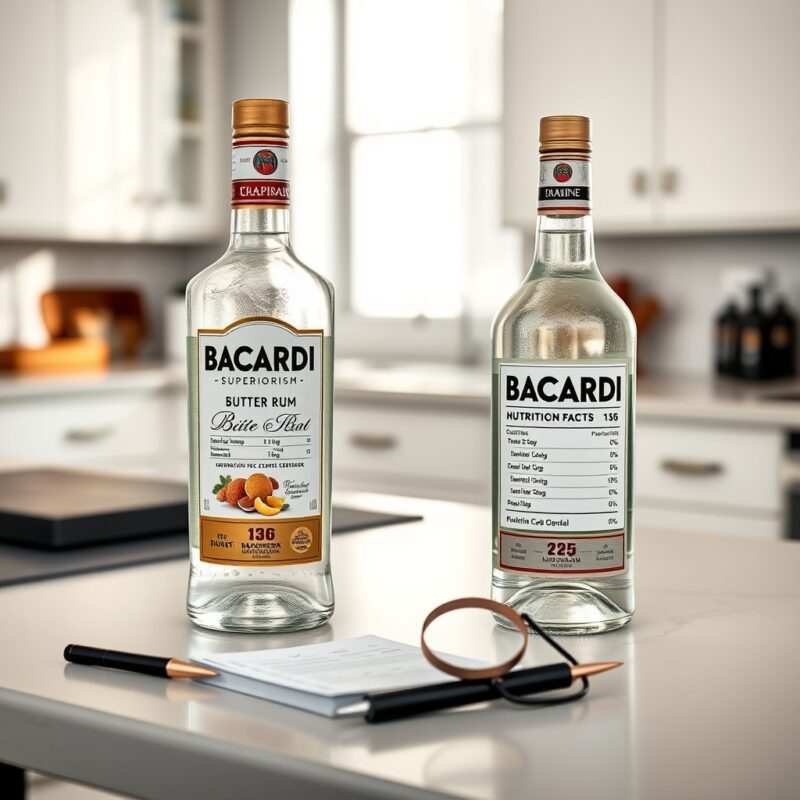
Generic branded-food nutrition label setup for Bacardi Bacardi Superior White Rum
  • Beverages
  • Food & Drink Nutrition Facts

Bacardi Superior White Rum Nutrition Facts

  • June 27, 2026
  • Joana Malheiro
Quick answer

Bacardi Superior White Rum is a branded food record in USDA FoodData Central. The selected record lists 171kcal, 8.24g protein, 17.1g carbohydrate, and 7.94g total fat. Values should be verified against the current product label before relying on them for comparison or product research.

Data source and label accuracy notice

Nutritional values on this page are based on USDA FoodData Central Branded Foods data. Branded product formulas, serving sizes, ingredients, and labels may change. Always verify values against the current product label before using them for dietary decisions, editorial comparisons, or product research.

Selected record: Bacardi Superior White Rum · Brand/owner: Bacardi · FDC ID: 2009302 · Data type: Branded.

This page is provided for educational and informational purposes only and is not medical advice.

Alcohol content note: This page is limited to nutrition-label and source-record information. It does not recommend alcohol consumption, does not frame alcohol as healthy, and should only be read by adults of legal drinking age.

Bacardi Superior White Rum nutrition facts label

Contents

  • 1 Bacardi Superior White Rum nutrition facts label
  • 2 What the branded record shows
  • 3 Ingredients and label-reading notes
  • 4 Bacardi Superior White Rum vs All rum 80-proof
  • 5 Current-label verification checklist
  • 6 Data source
  • 7 Frequently asked questions
    • 7.1 How many calories are in Bacardi Superior White Rum?
    • 7.2 Is this the same as the current product label?
    • 7.3 Why can branded food values change?
    • 7.4 Can this page replace personal nutrition advice?
  • 8 Related nutrition data resources
  • 9 Disclaimer

Serving basis: 340g. Values are based on USDA FoodData Central Branded Foods data and should be verified against the current product label.

Nutrient Amount %DV
Calories 581kcal —
Total Fat 27g 34%
Saturated Fat 14g 71%
Trans Fat 0g —
Cholesterol 109mg 37%
Sodium 1040mg 44%
Total Carbohydrate 58.1g 20%
Dietary Fiber 5.1g 17%
Total Sugars 5.98g —
Protein 28g 54%
Calcium 598mg 48%
Iron 4.49mg 24%
Label verification notice: Nutritional values on this page are based on USDA FoodData Central Branded Foods data. Always verify against the current product label as formulas may change.
Source: USDA FoodData Central Branded Foods. This table is for educational and informational purposes only and is not medical advice.

What the branded record shows

The selected USDA Branded Foods record identifies this product as Bacardi Superior White Rum from Bacardi. The main nutrition values should be treated as label-style product data, not as a generic food composition profile. Branded records are useful for packaged-product research, but they can become outdated if a company changes serving size, ingredients, or formulation.

For this selected record, key listed values include 171kcal, 8.24g protein, 17.1g carbohydrate, 7.94g total fat, 306mg sodium, and 1.76g total sugars. Added sugars are shown only when the USDA branded record provides a mapped added-sugars value.

Ingredients and label-reading notes

Ingredients listed in the USDA record: MARINARA SAUCE(DICED TOMATO [ TOMATOES, TOMATO JUICE, SALT, CITRIC ACID AND CALCIUM CHLORIDE] , ONION, CHARDONNAY WINE, OLIVE CANOLA OIL BLEND, SUGAR, GARLIC, BASIL, SALT, BLACK PEPPER, RED PEPPER FLAKES, BAY LEAF), FILLING(RICOTTA CHEESE [ WHOLE MILK, WHEY, VINEGAR, SALT] , PARMESAN CHEESE [ PASTEURIZED MILK, CULTURE, SALT, ENZYMES] , EGG, BASIL, OREGANO), PASTA(BROWN RICE, RICE BRAN AND WATER), LOW-MOISTURE PART-SKIM MOZZARELLA AND PROVOLONE CHEESE(PASTEURIZED REDUCED-FAT MILK, PASTEURIZED MILK CHEESE CULTURE, SALT, ENZYMES, POWDERED CELLULOSE ADDED TO PREVENT CAKING, NATURAL SMOKE FLAVOR, NATAMYCIN ADDED AS A MOLD INHIBITOR).

READ ALSO  What Is Glycemic Response in Nutrition?

Ingredient lists are usually ordered by weight on packaged foods. Review the current product package or official brand page before making a final label-reading judgment, especially for added sugars, sweeteners, flavors, thickeners, preservatives, allergens, or fortification claims.

Bacardi Superior White Rum vs All rum 80-proof

Use this branded page together with a generic reference page when comparing a packaged product to a simpler food category. A brand-specific record can show serving size, added sugars, sodium, ingredients, and formulation details that a generic food page may not show. The comparison should remain factual and should avoid personal dietary advice unless reviewed.

For a more precise comparison, use the Nutrition Lookup tool to compare this product with a matching generic food record or another branded product. Compare similar serving sizes and check whether both records use the same data type and nutrient basis.

Current-label verification checklist

  • Confirm the current product name and package size.
  • Confirm the serving size and grams per serving.
  • Compare calories, macros, sodium, sugars, and added sugars against the current label.
  • Check the ingredients list and allergen statement.
  • Check whether the brand has reformulated the product since the USDA record was published.

Data source

Data source: USDA FoodData Central Branded Foods. FDC ID: 2009302. Brand/owner: Bacardi. Last checked: 2026-06-27.

Disclosure: Nutritional values based on USDA FoodData Central data. Always verify against the current product label as formulas may change.

Citation: U.S. Department of Agriculture, Agricultural Research Service. FoodData Central. FDC ID 2009302. [Internet]. [cited 2026-06-27]. Available from https://fdc.nal.usda.gov/.

Frequently asked questions

How many calories are in Bacardi Superior White Rum?

The selected USDA Branded Foods record lists 171kcal for this product record. Check the current product label before relying on this value because branded serving sizes and formulas may change.

Is this the same as the current product label?

Not necessarily. USDA Branded Foods data is a useful starting point, but the current package label is the final source for a product being purchased today.

Why can branded food values change?

Brands can change ingredients, serving sizes, sweeteners, sodium levels, package sizes, or fortification. That is why this page includes a mandatory current-label verification notice.

Can this page replace personal nutrition advice?

No. This page is educational and informational only. It does not provide medical advice or individualized dietary guidance.

Related nutrition data resources

You can browse more profiles in Food & Drink Nutrition Facts, compare foods with the Nutrition Lookup tool, review our Nutrition Data Methodology, or read the Medical Disclaimer.

Disclaimer

Content on this page is provided for educational and informational purposes only and is not medical advice. Branded product labels may change; always verify the current package label before using values for dietary decisions, editorial comparisons, or product research.

Joana Malheiro
Joana Malheiro

Joana Malheiro is a Food Science Writer specializing in the clean label movement. She investigates ultra-processed foods (UPFs), ingredient supply chains, and artificial additives for eNutritionFacts.com. Read full author profile

Previous Article
Why Cooked Foods Can Show More Calories per 100g clean editorial nutrition education image
  • Raw vs Cooked Nutrition
  • Preparation Impact

Why Cooked Foods Can Show More Calories per 100g

  • June 27, 2026
  • Dania Rizvi
Read More
Next Article
Generic branded-food nutrition label setup for Patrón / Bacardi Patron Silver Tequila
  • Beverages
  • Food & Drink Nutrition Facts

Patron Silver Tequila Nutrition Facts

  • June 27, 2026
  • Joana Malheiro
Read More

Latest nutrition guides

Generic branded-food nutrition label setup for Patrón / Bacardi Patron Silver Tequila

Patron Silver Tequila Nutrition Facts

Patron Silver Tequila nutrition facts from USDA FoodData Central Branded Foods: calories, serving size, label values, ingredients when…

Why Cooked Foods Can Show More Calories per 100g clean editorial nutrition education image

Why Cooked Foods Can Show More Calories per 100g

Why Cooked Foods Can Show More Calories per 100g explained with cautious educational wording, internal links, methodology context,…

Liquid IV Ingredients

Liquid IV Ingredients: What Makes It Different from Other Hydration Mixes?

Liquid IV Ingredients: What Makes It Different from Other Hydration Mixes? explained with cautious educational wording, internal links,…

Natural Flavors on Food Labels clean editorial nutrition education image

Natural Flavors on Food Labels

Natural Flavors on Food Labels explained with cautious educational wording, internal links, methodology context, and saved-post review-ready structure.

How Protein Helps with Satiety clean editorial nutrition education image

How Protein Helps with Satiety

How Protein Helps with Satiety explained with cautious educational wording, internal links, methodology context, and saved-post review-ready structure.

Protein Distribution Across the Day Explained clean editorial nutrition education image

Protein Distribution Across the Day Explained

Protein Distribution Across the Day Explained explained with cautious educational wording, internal links, methodology context, and saved-post review-ready…

What Is Glycemic Response in Nutrition? clean editorial nutrition education image

What Is Glycemic Response in Nutrition?

What Is Glycemic Response in Nutrition? explained with cautious educational wording, internal links, methodology context, and saved-post review-ready…

What Does Bioengineered Food Ingredients Mean? clean editorial nutrition education image

What Does Bioengineered Food Ingredients Mean?

What Does Bioengineered Food Ingredients Mean? explained with cautious educational wording, internal links, methodology context, and saved-post review-read…

About eNutritionFacts
About Us
Our Expert Team
Contact
Sitemap
Editorial Standards
Editorial Guidelines
Nutrition Data Methodology
Expert Review Policy
Corrections & Updates Policy
Legal & Disclaimers
Medical Disclaimer
FTC & Affiliate Disclosure
Privacy Policy & Cookie Policy
Terms of Use
eNutritionFacts

© 2026 eNutritionFacts. All rights reserved. eNutritionFacts is owned and operated by FFMarketing.

Content on this site is provided for educational and informational purposes only and is not medical advice. eNutritionFacts may earn revenue from display ads, affiliate links, sponsored placements, or other commercial relationships. These relationships do not control our nutrition data, editorial standards, review policies, or correction decisions.

Input your search keywords and press Enter.