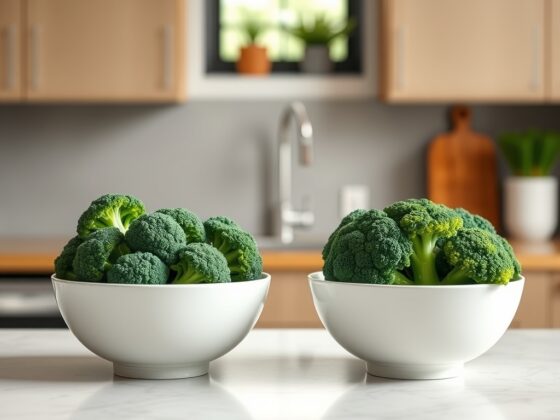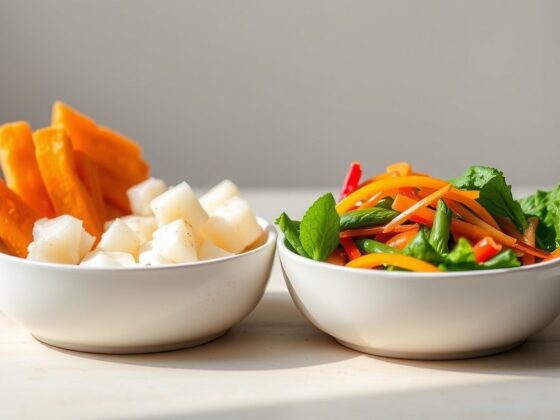
Food texture influences how quickly carbohydrates are digested and absorbed, which directly affects glycemic response—the rise in blood glucose after eating. When food is mechanically broken down through processes like grinding, mashing, or blending, the surface area available for digestive enzymes increases, accelerating starch breakdown and glucose release. Whole grains with intact kernels, for example, typically produce a slower glucose rise than finely milled flour from the same grain. Similarly, raw vegetables with firm cell walls require more digestive effort than cooked, softened versions. Particle size, cell-wall integrity, and the degree of gelatinization during cooking all contribute to these differences. Understanding these variables helps explain why two foods with identical carbohydrate content can produce different blood sugar responses, and why preparation method matters when interpreting glycemic impact.
What Food Texture Means in Glycemic Context
Texture refers to the physical structure of food—how intact or broken down it is at the time of consumption. In glycemic terms, texture determines how easily digestive enzymes can reach and break down starch molecules. Foods with coarse, intact structures resist rapid digestion because enzymes must penetrate cell walls and navigate larger particles. Foods that are ground, pureed, or extensively cooked offer less physical resistance, allowing enzymes to work faster and glucose to enter the bloodstream more quickly.
This relationship is independent of total carbohydrate content. Two servings of oats—one as steel-cut oats and one as instant oat flour—contain similar amounts of starch, but the flour version will typically produce a faster glucose rise because the starch granules are already exposed and partially gelatinized during processing.
How Particle Size Affects Digestion Speed
Particle size is one of the most measurable texture variables. When grains, legumes, or vegetables are ground into smaller particles, the total surface area increases exponentially. Digestive enzymes, particularly amylase, work at the surface of food particles. A whole grain kernel might have a surface area of a few square millimeters, while the same kernel ground into flour can have hundreds of times more surface area available for enzymatic contact.
Research comparing whole grains to flour shows that finely milled products produce higher peak glucose levels and faster absorption rates. This effect is consistent across grains: whole wheat berries versus whole wheat flour, intact barley versus barley flour, and whole corn kernels versus cornmeal all demonstrate the same pattern. The difference is not in nutrient composition but in how quickly those nutrients become accessible.
For practical purposes, this means that bread made from coarsely ground whole grains may produce a different glycemic response than bread made from finely milled whole-grain flour, even when both are labeled “100% whole grain.” The label does not capture particle size, which is a separate processing variable.
Cell-Wall Integrity and Starch Accessibility
Plant cell walls are composed of cellulose, hemicellulose, and pectin—structures that humans cannot digest. These walls act as physical barriers that slow enzyme access to intracellular starch. When cell walls remain intact, as in lightly cooked or raw vegetables, digestion proceeds more slowly. When cell walls are broken through mechanical processing (chopping, blending) or thermal processing (prolonged cooking), starch becomes more accessible.
Legumes illustrate this clearly. Whole cooked lentils retain much of their cell-wall structure, and starch granules remain encased within cells. Lentil puree or lentil flour, by contrast, has disrupted cell walls and exposed starch, leading to faster digestion. The same principle applies to potatoes: a boiled whole potato with skin has more intact cell structure than mashed potatoes, and mashed potatoes digest more slowly than potato puree or potato flakes.
Cooking method also affects cell-wall integrity. Steaming and boiling soften cell walls but may leave some structure intact, especially with shorter cooking times. Pressure cooking and prolonged boiling break down more cell-wall material. Blending mechanically ruptures cells, regardless of cooking method.
Gelatinization and Retrogradation
Starch exists in two forms: native (raw) and gelatinized (cooked). Native starch granules are tightly packed and resistant to enzyme action. When starch is heated in the presence of water, granules swell and the starch becomes gelatinized—a process that makes it much easier to digest. The degree of gelatinization depends on temperature, water content, and cooking time.
Highly gelatinized starches, such as those in instant oatmeal, white bread, or overcooked rice, are digested rapidly. Partially gelatinized starches, such as those in al dente pasta or lightly cooked grains, digest more slowly. Retrogradation—a process that occurs when cooked starch cools—can partially reverse gelatinization, forming resistant starch that is less digestible. This is why cold cooked potatoes or rice may produce a lower glycemic response than the same foods eaten hot.
Texture plays a role here because the physical form of the food influences how much water and heat penetrate during cooking. Whole grains with intact bran layers may gelatinize less completely than refined grains, even when cooked for the same duration.
Comparison Mistakes When Evaluating Texture
One common mistake is assuming that all “whole” foods have the same glycemic impact. Whole-grain bread and whole-grain berries are both whole foods, but their textures differ dramatically. The bread is made from flour, which has been milled to a fine particle size, while the berries are intact kernels. The glycemic response will differ accordingly.
Another mistake is ignoring preparation method when comparing foods. Raw carrots and cooked carrots have the same carbohydrate content per 100 grams, but cooking softens cell walls and increases starch digestibility. Similarly, blending a fruit into a smoothie changes its texture and digestion speed compared to eating the whole fruit, even though the fiber content remains the same.
It is also incorrect to assume that texture is the only variable. Fiber type, fat content, protein content, and the presence of anti-nutrients (such as phytates or tannins) all influence glycemic response. Texture is one factor among several, and its impact is most pronounced when other variables are held constant.
When to Use Nutrition Lookup for Texture Context
The Nutrition Lookup tool provides access to USDA FoodData Central records, which include preparation descriptors such as “raw,” “cooked,” “mashed,” or “pureed.” These descriptors offer clues about texture, though they do not quantify particle size or cell-wall integrity.
Use the tool when you need to compare the same food in different forms—for example, “Lentils, mature seeds, cooked, boiled, without salt” versus “Lentils, mature seeds, cooked, boiled, with salt, mashed.” The nutrient profiles may be similar, but the preparation descriptor signals a texture difference that could affect digestion speed.
The tool is also useful for identifying whether a food record represents a whole or processed form. For instance, “Oats, whole grain” versus “Oats, instant, fortified, plain, dry” indicates different levels of processing and, by extension, different textures and likely different glycemic responses.
For broader context on how food choices relate to blood sugar management, see the Metabolic Nutrition Guide and explore additional resources in the Metabolic Nutrition category.
Practical Checklist for Texture and Glycemic Response
- Choose whole, intact forms when possible: Whole grains, whole legumes, and whole vegetables generally digest more slowly than their ground or pureed counterparts.
- Consider particle size: Coarsely ground or cracked grains may produce a slower glucose rise than finely milled flour.
- Monitor cooking time and method: Shorter cooking times and methods that preserve cell-wall structure (steaming, light boiling) may slow digestion compared to prolonged cooking or pressure cooking.
- Account for cooling: Allowing cooked starches to cool before eating can increase resistant starch content and may lower glycemic response.
- Avoid over-processing: Blending, mashing, or pureeing increases surface area and speeds digestion, even when fiber content is unchanged.
- Check preparation descriptors in food databases: Use Nutrition Lookup to identify whether a food record represents a whole or processed form.
- Combine texture with other variables: Pair high-texture foods with protein, fat, or fiber-rich additions to further moderate glycemic response.
Frequently Asked Questions
Does blending a fruit remove its fiber?
No, blending does not remove fiber. However, it breaks down cell walls and reduces particle size, which can speed digestion and glucose absorption compared to eating the whole fruit. The fiber is still present, but its physical structure is altered.
Is instant oatmeal less nutritious than steel-cut oats?
Instant oatmeal and steel-cut oats have similar macronutrient and micronutrient profiles. The primary difference is texture: instant oats are pre-cooked and rolled thin, which increases surface area and speeds digestion. Steel-cut oats are minimally processed and retain a coarser texture, leading to slower digestion.
Does cooking vegetables always increase their glycemic response?
Cooking softens cell walls and can increase starch digestibility, which may raise glycemic response. However, the effect varies by vegetable, cooking method, and duration. Lightly steamed vegetables may have a minimal change, while overcooked or pureed vegetables are more likely to show a faster glucose rise.
Can I lower the glycemic response of mashed potatoes?
Cooling mashed potatoes after cooking can increase resistant starch content, which may lower glycemic response. Adding fat (such as olive oil or butter) or protein (such as Greek yogurt) can also slow digestion. However, the texture change from mashing still increases surface area compared to whole boiled potatoes.
Does whole-grain bread have the same glycemic response as whole grains?
Not necessarily. Whole-grain bread is made from flour, which has a fine particle size and high surface area. Whole grains in intact kernel form (such as wheat berries or barley) have a coarser texture and typically produce a slower glucose rise, even though both contain the entire grain.
Is there a way to measure texture at home?
Texture is difficult to measure precisely without laboratory equipment. However, you can make qualitative assessments: foods that require more chewing, have visible intact particles, or retain firmness after cooking are likely to have slower digestion than soft, smooth, or finely ground versions.
Sources and Methodology
This article synthesizes evidence from food science and nutrition research on starch digestion, particle size, and glycemic response. Data on food preparation and nutrient composition are drawn from USDA FoodData Central, accessible via Nutrition Lookup. Descriptions of gelatinization, retrogradation, and cell-wall structure are based on established food chemistry principles. For a full explanation of how eNutritionFacts evaluates and presents nutrition data, see Data Methodology. Expert review processes are detailed in the Expert Review Policy.
Educational Disclaimer
This content is for educational purposes only and does not constitute medical advice, diagnosis, or treatment. Individual glycemic responses vary based on metabolic health, meal composition, physical activity, and other factors. Readers managing diabetes, prediabetes, or other metabolic conditions should consult a qualified healthcare provider before making dietary changes. eNutritionFacts does not recommend specific foods or preparation methods for disease management. For full terms, see the Medical Disclaimer.