
eNutritionFacts
  • Nutrition Database
    • Nutrition Lookup
    • Food & Drink Nutrition Facts
    • Semantic Food Comparison Engine
    • Nutrient Ranking Tool
    • Nutrition Data Methodology
  • Nutrition Topics
    • Nutrition Label Guides
    • Clean Label & Ingredients
    • Preparation Impact
  • Editorial Standards
    • Our Story & Mission
    • Expert Team
    • Editorial Guidelines & Fact-Checking Policy
    • Nutrition Data Methodology
    • Expert Review Policy
    • Corrections & Update Policy
    • Advertising & Affiliate Disclosure
    • Medical Disclaimer
  • Tools
    • Core Tools
      • Nutrition Lookup
      • Food Comparison Engine
      • Recipe Nutrition Calculator
      • Serving Size & %DV Label Converter
    • Research & Interpretation Tools
      • Nutrient Ranking Tool
      • Preparation Impact Estimator
      • Bioavailability Context Explainer
      • Nutrient Interaction Graph Explorer
    • Planning & Synthesis Tools
      • Macro Target Estimator
      • Meal Synthesizer
      • Amino Acid Complementarity Estimator
    • Verification & Governance Tools
      • Nutrient Data Provenance
      • Nutrition Data Provenance Ledger
      • Research Contribution Portal
      • Nutrition datasets
      • Semantic Graph Engine
  • Contact
Recent Posts
  • What Does Protein Mean on a Nutrition Label?
  • What Does Total Carbohydrate Mean on a Nutrition Label?
  • What Does Dietary Fiber Mean on a Nutrition Label?
  • What Does Sodium Mean on a Nutrition Label?
  • Strawberries Nutrition Facts
  • Avocados Nutrition Facts
  • Lentils Nutrition Facts
  • Blueberries Nutrition Facts
  • Raw Kale Nutrition Facts
  • Butternut Mountain Farm Maple Syrup Nutrition Facts

Categories

  • Clean Label & Ingredients
  • Food & Drink Nutrition Facts
  • Nutrition Label Guides
  • Preparation Impact
eNutritionFacts
eNutritionFacts
  • Nutrition Database
    • Nutrition Lookup
    • Food & Drink Nutrition Facts
    • Semantic Food Comparison Engine
    • Nutrient Ranking Tool
    • Nutrition Data Methodology
  • Nutrition Topics
    • Nutrition Label Guides
    • Clean Label & Ingredients
    • Preparation Impact
  • Editorial Standards
    • Our Story & Mission
    • Expert Team
    • Editorial Guidelines & Fact-Checking Policy
    • Nutrition Data Methodology
    • Expert Review Policy
    • Corrections & Update Policy
    • Advertising & Affiliate Disclosure
    • Medical Disclaimer
  • Tools
    • Core Tools
      • Nutrition Lookup
      • Food Comparison Engine
      • Recipe Nutrition Calculator
      • Serving Size & %DV Label Converter
    • Research & Interpretation Tools
      • Nutrient Ranking Tool
      • Preparation Impact Estimator
      • Bioavailability Context Explainer
      • Nutrient Interaction Graph Explorer
    • Planning & Synthesis Tools
      • Macro Target Estimator
      • Meal Synthesizer
      • Amino Acid Complementarity Estimator
    • Verification & Governance Tools
      • Nutrient Data Provenance
      • Nutrition Data Provenance Ledger
      • Research Contribution Portal
      • Nutrition datasets
      • Semantic Graph Engine
  • Contact
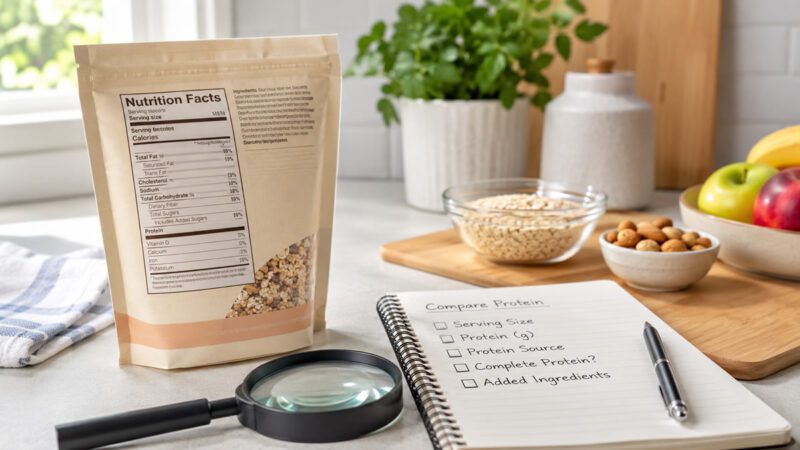
Generic nutrition facts label with checklist for protein comparison
  • Nutrition Label Guides

What Does Protein Mean on a Nutrition Label?

  • May 22, 2026
  • Dania Rizvi

Protein on a Nutrition Facts label shows the grams of protein in one serving. It is read together with the serving size because the number usually applies to one listed serving, not necessarily the whole package. The label line is useful for comparing similar foods, but it should not be treated as a personal nutrition target or medical instruction. To use the number clearly, check the serving size first, then read the protein amount, the Percent Daily Value when shown, nearby nutrient lines, and the ingredient list. This guide explains the label meaning in plain language so readers can compare packaged foods without turning one number into a full judgment about the food.

Quick answer

Protein means the grams of protein in one serving. Read it in grams, start with serving size, and use % Daily Value only as a general comparison tool. The ingredient list and nearby nutrient lines help explain what the number means in context.

This article is a label-reading guide. It does not tell you how much protein you personally should eat, and it does not replace guidance from a qualified professional when individual nutrition needs matter.

What Protein Means on the Label

Contents

  • 1 What Protein Means on the Label
  • 2 Label Anatomy: Where Protein Appears
  • 3 Why Serving Size Matters
  • 4 How % Daily Value Helps Comparison
  • 5 What Else to Read Beside Protein
  • 6 How to Compare Two Products
  • 7 Common Protein Label Mistakes
  • 8 Simple Protein Checklist
  • 9 FAQ
    • 9.1 What does Protein mean on a Nutrition Facts label?
    • 9.2 Is Protein shown for the whole package?
    • 9.3 Should I use grams or Percent Daily Value?
    • 9.4 Can two similar foods show different protein values?
    • 9.5 Is the label number personal nutrition advice?
  • 10 Sources and Methodology

Protein is a Nutrition Facts label line that gives a measured amount for one serving. The value is normally shown in grams. This makes the line a measurement first, not a score, claim, or instruction.

The phrase “per serving” is the key to reading it correctly. If the serving size changes, the amount of protein being compared also changes. A product can look different when the serving size is small, large, or not similar to the product beside it.

For the full label-reading process, start with How to Read Nutrition Facts Labels. That guide explains why the top of the panel should be checked before comparing any single nutrient line.

Label Anatomy: Where Protein Appears

On most packaged foods, Protein appears near the bottom of the main nutrient section, after the carbohydrate lines on many Nutrition Facts labels. The visual layout can vary slightly by package size and label format, but the meaning stays tied to the serving size shown at the top of the panel.

A practical reading order is: serving size, calories, the nutrient line you are checking, Percent Daily Value when available, and then the ingredient list. This order helps avoid judging a product from one isolated number.

Why Serving Size Matters

Nutrition Facts values usually apply to one listed serving. If a food lists one serving as one bar, the protein value applies to one bar. If the serving is two tablespoons, the value applies to two tablespoons. Eating more or less than the listed serving changes the amount consumed.

This is why two products should not be compared until their serving sizes are checked. If one product uses a 30 g serving and another uses a 55 g serving, the label numbers are not based on the same amount of food. For more detail, read What Does Serving Size Mean on a Nutrition Label?.

How % Daily Value Helps Comparison

Percent Daily Value, often written as %DV, helps readers compare how much a serving contributes to a general daily reference amount. It is a comparison shortcut, not a personalized target.

When a Percent Daily Value is shown for protein, it is a general label-reference number and not a personalized protein target. FDA label education also uses the general guide that 5% Daily Value or less is low and 20% Daily Value or more is high for a nutrient per serving. For a fuller explanation, read What Does Percent Daily Value Mean on a Nutrition Label?.

What Else to Read Beside Protein

Protein does not tell the full food story by itself. Serving size, ingredient list, total calories, saturated fat, sodium, and the food type still matter for label comparison. The ingredient list can also explain why two similar products show different numbers. Recipes, processing choices, added ingredients, serving sizes, and preparation forms can all change how a label looks.

Protein grams are not the same as protein quality, digestibility, or personal protein needs. The label line is a quantity measure for one serving. For related label context, read What Does Total Carbohydrate Mean on a Nutrition Label?. For related label context, read What Does Added Sugar Mean on a Nutrition Label?.

How to Compare Two Products

When comparing two similar products, first check whether the serving sizes are similar. Then compare the protein amount, % Daily Value when shown, calories, and nearby nutrient lines. Finally, read the ingredient list to understand the food context.

Use the Nutrition Label Guides category for related plain-English label explanations. The goal is to compare labels more clearly, not to turn one label number into a complete nutrition rule.

Common Protein Label Mistakes

  • Reading Protein before checking serving size.
  • Comparing products with different serving weights or serving units.
  • Treating % Daily Value as a personal target instead of a general label reference.
  • Ignoring the ingredient list and nearby nutrient lines.
  • Trusting front-of-pack claims without checking the full Nutrition Facts label.

Simple Protein Checklist

  • Start with the serving size and servings per container.
  • Find the Protein line.
  • Read the value in grams.
  • Check % Daily Value when it is shown.
  • Read nearby nutrient lines for context.
  • Use the ingredient list to understand the product.
  • Compare similar products using similar serving sizes.

FAQ

What does Protein mean on a Nutrition Facts label?

Protein means the grams of protein in one serving. It should be read with the serving size because Nutrition Facts values usually apply to one listed serving.

Is Protein shown for the whole package?

Usually, no. The number is normally shown for one serving. If a package contains more than one serving, the full-package amount may be higher than the number shown for one serving.

Should I use grams or Percent Daily Value?

Use both when they are available. Grams show the measured amount, while % Daily Value helps compare the serving with a general label-reference amount.

Can two similar foods show different protein values?

Yes. Recipe, serving size, ingredients, food form, and label format can all affect the number. Compare similar products using similar serving sizes for a fairer reading.

Is the label number personal nutrition advice?

No. The Nutrition Facts label is a general information tool. It can help with comparison, but it does not replace individualized guidance when someone has specific nutrition needs.

Sources and Methodology

This article uses U.S. Food and Drug Administration Nutrition Facts label guidance to explain serving size, nutrient labeling, Daily Value, and Percent Daily Value as label-reading concepts. It is written as general food-label education, not as personalized dietary advice.

For more detail about how eNutritionFacts handles source-backed nutrition explanations, see our Nutrition Data Methodology and Expert Review Policy.

This article is for educational and informational purposes only and is not medical advice. Individual nutrition needs may vary. For personalized dietary guidance, consult a qualified professional. See the Medical Disclaimer.

Dania Rizvi
Dania Rizvi

Dania Rizvi is a meticulous Nutrition Researcher and data journalist. She specializes in extracting, structuring, and analyzing complex micro and macronutrient profiles for eNutritionFacts.com. Read full author profile

Previous Article
Generic nutrition facts label with checklist for total carbohydrate comparison
  • Nutrition Label Guides

What Does Total Carbohydrate Mean on a Nutrition Label?

  • May 22, 2026
  • Dania Rizvi
Read More

Leave a Reply Cancel reply

Your email address will not be published. Required fields are marked *

Latest nutrition guides

Generic nutrition facts label with checklist for total carbohydrate comparison

What Does Total Carbohydrate Mean on a Nutrition Label?

Learn what Total Carbohydrate means on Nutrition Facts labels, what it includes, how serving size affects the number,…

Generic nutrition facts label with checklist for dietary fiber comparison

What Does Dietary Fiber Mean on a Nutrition Label?

Learn what dietary fiber means on Nutrition Facts labels, where it appears under Total Carbohydrate, how % Daily…

Generic nutrition facts label with sodium line and checklist for sodium comparison

What Does Sodium Mean on a Nutrition Label?

Learn what sodium means on Nutrition Facts labels, how % Daily Value works, why serving size matters, and…

enutritionfacts_label

Strawberries Nutrition Facts

Source-backed strawberries nutrition facts with calories, macros, per 100g values, serving-size data when available, FDC ID 167762, and…

enutritionfacts_label

Avocados Nutrition Facts

Source-backed avocados nutrition facts with calories, macros, per 100g values, serving-size data when available, FDC ID 171705, and…

enutritionfacts_label

Lentils Nutrition Facts

Source-backed lentils nutrition facts with calories, macros, per 100g values, serving-size data when available, FDC ID 172421, and…

enutritionfacts_label

Blueberries Nutrition Facts

Source-backed blueberries nutrition facts with calories, macros, per 100g values, serving-size data when available, FDC ID 171711, and…

enutritionfacts_label

Raw Kale Nutrition Facts

Source-backed raw kale nutrition facts with calories, macros, per 100g values, serving-size data when available, FDC ID 168421,…

About eNutritionFacts
About Us
Our Expert Team
Contact
Sitemap
Editorial Standards
Editorial Guidelines
Nutrition Data Methodology
Expert Review Policy
Corrections & Updates Policy
Legal & Disclaimers
Medical Disclaimer
FTC & Affiliate Disclosure
Privacy Policy & Cookie Policy
Terms of Use
eNutritionFacts

© 2026 eNutritionFacts. All rights reserved. eNutritionFacts is owned and operated by FFMarketing.

Content on this site is provided for educational and informational purposes only and is not medical advice. eNutritionFacts may earn revenue from display ads, affiliate links, sponsored placements, or other commercial relationships. These relationships do not control our nutrition data, editorial standards, review policies, or correction decisions.

Input your search keywords and press Enter.