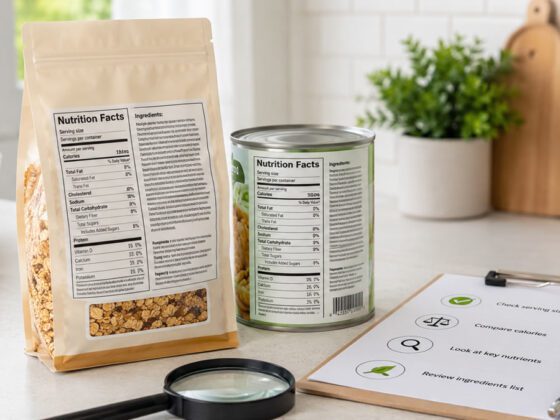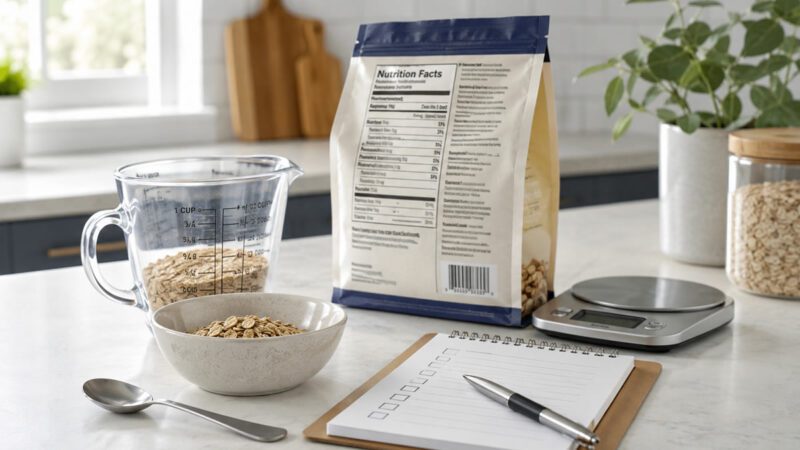
Serving size is the amount of food or drink used as the basis for the Nutrition Facts label. Calories, nutrients, percent Daily Value, added sugars, sodium, fiber, protein, fat, carbohydrates, vitamins, and minerals are usually listed for one serving of the product.
This guide explains what serving size means, how servings per container work, and why the same food can look very different depending on the serving amount used on the label.
What Is Serving Size on a Nutrition Facts Label?
Contents
- 1 What Is Serving Size on a Nutrition Facts Label?
- 2 Serving Size Is Not Always a Recommended Portion
- 3 What Does Servings Per Container Mean?
- 4 How Serving Size Changes the Nutrition Numbers
- 5 Why Serving Size Can Be Confusing
- 6 Serving Size vs Portion Size
- 7 How to Adjust Label Values for Your Portion
- 8 Why Similar Foods Should Be Compared by Similar Serving Sizes
- 9 When a Label Shows Per Serving and Per Package
- 10 Common Serving Size Mistakes
- 11 Simple Serving Size Checklist
- 12 How This Connects to Nutrition Label Reading
- 13 Bottom Line
- 14 Sources and Methodology
Serving size is the reference amount used to calculate the values shown on the Nutrition Facts label. It is usually shown near the top of the label as a familiar household measure, followed by a metric amount.
For example, a label might list serving size as 1 cup, 2 pieces, 1 slice, 1 bar, 2 tablespoons, or 30 grams. The household measure helps readers picture the amount, while the gram or milliliter value gives a more precise measurement.
The most important rule is simple: the numbers on the label usually apply to the listed serving size. If your actual portion is larger or smaller, the nutrition values change with it.
Serving Size Is Not Always a Recommended Portion
A common mistake is thinking that serving size means the amount someone should eat. On a Nutrition Facts label, serving size is mainly a labeling reference. It is based on amounts commonly eaten, not a personal eating instruction.
This matters because people may eat more or less than the listed serving. A small snack package, drink bottle, frozen meal, cereal bowl, or dessert may contain more than one serving, even if it looks like a single portion at first glance.
For practical label reading, compare the listed serving size with your actual portion. That comparison tells you whether the label values need to be adjusted.
What Does Servings Per Container Mean?
Servings per container tells you how many label servings are in the full package. This number is just as important as serving size because it helps explain the total amount in the container.
If a package lists 150 calories per serving and has 2 servings per container, the full package provides about 300 calories if the entire package is eaten. The same multiplication applies to sodium, added sugar, fat, carbohydrates, protein, fiber, vitamins, and minerals.
| Label Information | What It Means | How to Read It |
|---|---|---|
| Serving size: 1 cup | The label values are based on 1 cup. | If you eat 2 cups, the listed values are usually doubled. |
| Servings per container: 2 | The package contains 2 label servings. | If you eat the full package, you are eating 2 servings. |
| Calories: 200 per serving | One listed serving provides 200 calories. | The full 2-serving package would provide about 400 calories. |
How Serving Size Changes the Nutrition Numbers
Nutrition Facts values scale with the amount eaten. If you eat twice the listed serving size, you usually get about twice the listed calories and nutrients. If you eat half the listed serving size, you usually get about half.
This is why serving size can change how a food appears on a label. A product may look lower in sodium, sugar, or calories if the serving size is small. Another product may look higher simply because the serving size is larger.
When comparing two similar products, always check whether the serving sizes are similar before comparing the numbers.
Why Serving Size Can Be Confusing
Serving size can be confusing because package size, serving size, and actual portion size are not always the same thing.
- The package size is the total amount of food or drink in the container.
- The serving size is the amount used for the Nutrition Facts label.
- The portion size is the amount someone actually eats or drinks.
These three amounts may match, but they often do not. For example, a drink bottle may contain more than one serving, a bag of snacks may list a smaller serving than the amount commonly eaten, and a cereal serving may be smaller than what someone pours into a bowl.
For a deeper explanation, read our guide on what serving size means on a Nutrition Facts label.
Serving Size vs Portion Size
Serving size and portion size are related, but they are not the same. Serving size is the label amount. Portion size is the amount actually eaten.
| Term | Meaning | Example |
|---|---|---|
| Serving size | The amount used for the Nutrition Facts label. | The label says 1 cup. |
| Portion size | The amount someone actually eats or drinks. | You eat 2 cups. |
| Package size | The total amount in the container. | The container holds 3 cups. |
For accurate label reading, the key question is: how does my actual portion compare with the listed serving size?
How to Adjust Label Values for Your Portion
You do not need a complex calculation for most everyday label reading. Use simple multiplication or division.
- If you eat 2 servings, multiply the label values by 2.
- If you eat 3 servings, multiply the label values by 3.
- If you eat half a serving, divide the label values by 2.
- If you eat the full package, multiply by the number of servings per container.
For example, if one serving has 250 mg sodium and you eat two servings, the amount eaten provides about 500 mg sodium. If one serving has 8 grams of added sugar and you eat half a serving, the amount eaten provides about 4 grams of added sugar.
Why Similar Foods Should Be Compared by Similar Serving Sizes
Serving size is especially important when comparing similar foods. Two products can look very different if one label uses a larger serving size than the other.
For example, if two cereals are compared but one serving is 30 grams and the other is 55 grams, the larger serving may naturally show more calories, carbohydrates, sugar, protein, and fiber. A fairer comparison may require checking values per 100 grams or adjusting the numbers to a similar serving weight.
The same issue can appear with snacks, drinks, yogurt, bread, frozen meals, sauces, and protein bars. Always check the listed serving amount before deciding which product is higher or lower in a nutrient.
When a Label Shows Per Serving and Per Package
Some Nutrition Facts labels may show information in two columns: one column for one serving and another for the full package or full container. This can make it easier to understand the total nutrition amount if the entire package is eaten.
When a dual-column label is present, check which column matches how much you plan to eat. If you eat the whole container, the full-package column is usually the more relevant one.
Common Serving Size Mistakes
The most common serving size mistake is reading calories, sodium, added sugar, or fat without checking the serving size first. Another common mistake is assuming that one package equals one serving.
It is also easy to compare products unfairly when the serving sizes are different. A smaller serving can make a food look lower in calories or sodium even when the actual amount eaten may be similar or higher.
- Do not assume the full package is one serving.
- Do not compare products before checking serving weight.
- Do not read calories without checking servings per container.
- Do not treat serving size as a personal eating rule.
Simple Serving Size Checklist
- Find the serving size at the top of the label.
- Check the household measure and the gram or milliliter amount.
- Check servings per container.
- Compare the listed serving size with your actual portion.
- Multiply the label values if eating more than one serving.
- Compare similar foods using similar serving sizes or similar weights.
How This Connects to Nutrition Label Reading
Serving size is the starting point for reading a Nutrition Facts label. Calories, % Daily Value, added sugars, sodium, fiber, protein, fat, carbohydrates, vitamins, and minerals all depend on the listed serving amount.
For the full step-by-step guide, read How to Read Nutrition Facts Labels. You can also explore more articles in the Nutrition Label Guides category.
Bottom Line
Serving size is the amount used to calculate the Nutrition Facts label. It is not always the amount someone personally eats, and it is not always the same as the full package.
To read labels clearly, start with serving size, check servings per container, compare the label serving with your actual portion, and adjust the numbers when eating more or less than one serving.
Sources and Methodology
This article is based on U.S. Food and Drug Administration educational guidance on Nutrition Facts label serving size, servings per container, and label-reading principles. It explains serving size as a label interpretation tool, not as a personalized eating recommendation.
This article is for educational and informational purposes only and is not medical advice. Individual nutrition needs may vary.