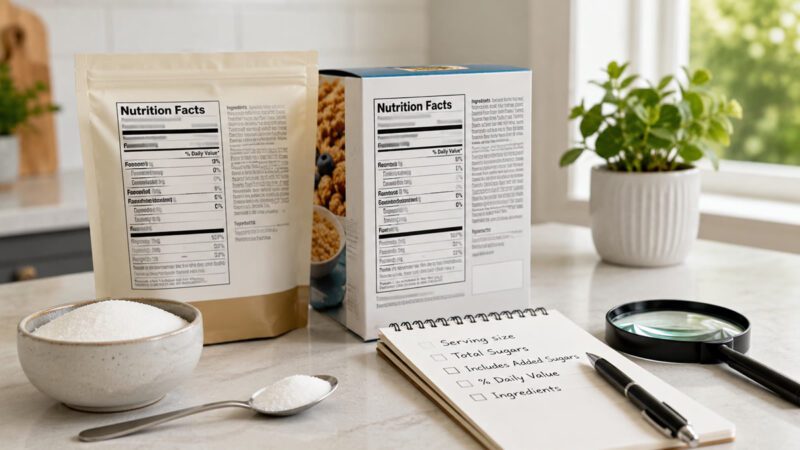
Added sugar on a Nutrition Facts label refers to sugars added during food processing or preparation. It is listed separately from total sugars so readers can see how much sugar was added to the product, rather than only seeing the total amount of sugar in one serving.
This guide explains what added sugar means, how it differs from total sugar, how % Daily Value works, and how to use the ingredient list to spot added sweeteners.
What Is Added Sugar on a Nutrition Facts Label?
Contents
- 1 What Is Added Sugar on a Nutrition Facts Label?
- 2 Total Sugar vs Added Sugar
- 3 What Counts as Added Sugar?
- 4 What Does Not Count as Added Sugar?
- 5 How Added Sugar Appears on the Label
- 6 What Is the Daily Value for Added Sugar?
- 7 Why Serving Size Matters
- 8 Common Foods Where Added Sugar Can Appear
- 9 How to Spot Added Sugar in the Ingredient List
- 10 Does “No Added Sugar” Mean Sugar-Free?
- 11 Does “Less Sugar” Always Mean Lower Added Sugar?
- 12 Simple Added Sugar Label Checklist
- 13 How This Connects to Nutrition Label Reading
- 14 Bottom Line
- 15 Sources and Methodology
Added sugar is the amount of sugar added to a food or drink during processing, manufacturing, or preparation. On many Nutrition Facts labels, it appears under total sugars as “Includes Xg Added Sugars.”
This separate line helps readers understand whether the sugar in a product comes only from naturally occurring sugars, or whether some sugar was added as an ingredient.
For example, plain milk contains naturally occurring sugar called lactose. Plain fruit contains naturally occurring sugars. A sweetened yogurt, flavored milk, soda, cereal, sauce, dessert, or snack bar may contain both naturally occurring sugars and added sugars depending on the ingredients.
Total Sugar vs Added Sugar
Total sugar includes all sugars in one serving of the food. This includes sugars naturally present in the ingredients plus sugars added during processing or preparation.
Added sugar is the part of total sugar that was added to the food. This is why added sugars are listed underneath total sugars on the Nutrition Facts label.
| Label Term | What It Means | Example |
|---|---|---|
| Total sugars | All sugars in one serving, including natural and added sugars. | A fruit yogurt may contain sugars from milk, fruit, and added sweeteners. |
| Added sugars | Sugars added during processing or preparation. | Sugar, syrup, honey, dextrose, or concentrated juice used for sweetening. |
| 0g added sugars | No sugar was added as part of the product formulation. | A food may still contain naturally occurring sugars. |
A product can have total sugars but 0 grams of added sugar. This can happen when the sugar comes naturally from ingredients such as plain milk or fruit.
What Counts as Added Sugar?
Added sugars can appear under many different names in the ingredient list. Some are easy to recognize, while others are less obvious.
- Sugar, cane sugar, brown sugar, raw sugar, or invert sugar.
- Sucrose, dextrose, fructose, glucose, maltose, or lactose when added as ingredients.
- Corn syrup, high-fructose corn syrup, rice syrup, maple syrup, or agave syrup.
- Honey, molasses, fruit syrup, or date syrup.
- Concentrated fruit or vegetable juices used for sweetening.
The ingredient list can help confirm where added sweetness is coming from. Ingredients are usually listed in descending order by weight, so sweeteners near the beginning of the list can tell you more about the product’s composition.
What Does Not Count as Added Sugar?
Naturally occurring sugars in plain foods are not the same as added sugars on the label. For example, sugars naturally found in plain milk, plain yogurt, whole fruit, and vegetables are not counted as added sugars unless sugar-containing ingredients are added during processing.
This distinction is useful because two products can have similar total sugars but different added sugar amounts. A plain yogurt may contain total sugars from milk, while a flavored yogurt may contain both milk sugar and added sweeteners.
How Added Sugar Appears on the Label
On a Nutrition Facts label, added sugars are usually listed in grams and as % Daily Value. The grams show the amount of added sugar in one serving. The % Daily Value helps show how much that serving contributes to the general daily reference amount.
For example, a label might say “Includes 10g Added Sugars” and show 20% Daily Value. That means one serving contains 10 grams of added sugars and contributes 20% of the general Daily Value for added sugars.
For a deeper explanation, read our guide on what added sugar means on a Nutrition Facts label.
What Is the Daily Value for Added Sugar?
The Daily Value for added sugars on U.S. Nutrition Facts labels is 50 grams per day based on a 2,000-calorie daily diet. This is a general label reference, not a personalized target for every person.
Because the Daily Value is 50 grams, each gram of added sugar equals about 2% Daily Value. For example, 5 grams of added sugar is about 10% Daily Value, and 10 grams is about 20% Daily Value.
| Added Sugar Per Serving | Approximate % Daily Value | Plain-English Meaning |
|---|---|---|
| 2.5 g | 5% DV | Low per serving. |
| 5 g | 10% DV | Moderate reference point for comparison. |
| 10 g | 20% DV | High per serving. |
| 25 g | 50% DV | Half of the general Daily Value in one serving. |
For a deeper explanation of % Daily Value, read our guide on what Percent Daily Value means on a Nutrition Facts label.
Why Serving Size Matters
Added sugar values are based on the listed serving size. If you eat more than one serving, the added sugar amount increases with the amount eaten. If you eat less than one serving, the amount decreases.
For example, if one serving has 8 grams of added sugar and you eat two servings, the amount eaten provides about 16 grams of added sugar. If one serving has 12 grams and you eat half a serving, the amount eaten provides about 6 grams.
This is why serving size should always be checked before reading added sugar values. For more detail, see our guide on what serving size means on a Nutrition Facts label.
Common Foods Where Added Sugar Can Appear
Added sugar is common in sweet foods and drinks, but it can also appear in products that do not taste like desserts. Checking the label is more reliable than guessing from the product name.
- Soft drinks, fruit drinks, flavored waters, and sweetened teas.
- Sweetened yogurts, flavored milks, and dairy desserts.
- Breakfast cereals, granola, cereal bars, and snack bars.
- Cookies, cakes, pastries, candy, ice cream, and desserts.
- Sauces, ketchup, barbecue sauce, salad dressings, and marinades.
- Packaged snacks, instant oatmeal, and some ready-to-eat meals.
This does not mean these foods must always be avoided. The useful step is to compare similar products, check the serving size, and understand how much added sugar one serving provides.
How to Spot Added Sugar in the Ingredient List
The Nutrition Facts label gives the grams and % Daily Value. The ingredient list shows which sweeteners were used. Reading both gives a clearer picture.
Look for words such as sugar, syrup, honey, molasses, nectar, dextrose, fructose, glucose, sucrose, maltose, corn syrup, high-fructose corn syrup, rice syrup, agave, cane juice, fruit juice concentrate, or other sweetening ingredients.
A product with several sweeteners may spread sugar across multiple ingredient names. That is why it is useful to scan the full ingredient list instead of looking for only the word “sugar.”
Does “No Added Sugar” Mean Sugar-Free?
No. “No added sugar” does not always mean sugar-free. It usually means no sugar-containing ingredient was added during processing or preparation, but the food may still contain naturally occurring sugars.
For example, a product made with fruit or milk may contain total sugars even if it has no added sugars. To understand the full label, check both total sugars and added sugars.
Does “Less Sugar” Always Mean Lower Added Sugar?
Not always. A “less sugar” claim should still be checked against the Nutrition Facts label. Look at total sugars, added sugars, serving size, and the ingredient list.
Some products reduce sugar by changing serving size, using non-sugar sweeteners, adding fiber ingredients, or changing the product formula. The full label gives more context than the front-of-pack claim alone.
Simple Added Sugar Label Checklist
- Start with serving size.
- Check total sugars.
- Check “Includes Xg Added Sugars.”
- Read the % Daily Value for added sugars.
- Scan the ingredient list for sweetener names.
- Compare similar products using similar serving sizes.
- Do not assume “no added sugar” means sugar-free.
How This Connects to Nutrition Label Reading
Added sugar is one of the most important label lines to read together with serving size, % Daily Value, total carbohydrate, ingredients, and front-of-pack claims. It helps explain how much sweetness was added to the product rather than only showing total sugar.
For the full step-by-step guide, read How to Read Nutrition Facts Labels. You can also explore more articles in the Nutrition Label Guides category.
Bottom Line
Added sugar on a Nutrition Facts label means sugar added during processing or preparation. It is listed separately from total sugars to help readers understand how much sugar was added to one serving of the food.
To read added sugar clearly, start with serving size, check grams and % Daily Value, compare similar products, and use the ingredient list to identify sweeteners.
Sources and Methodology
This article is based on U.S. Food and Drug Administration educational guidance on added sugars on the Nutrition Facts label, including the difference between total sugars and added sugars, the Daily Value for added sugars, and label-reading principles.
This article is for educational and informational purposes only and is not medical advice. Nutrition labels can help with food comparison, but individual nutrition needs may vary.