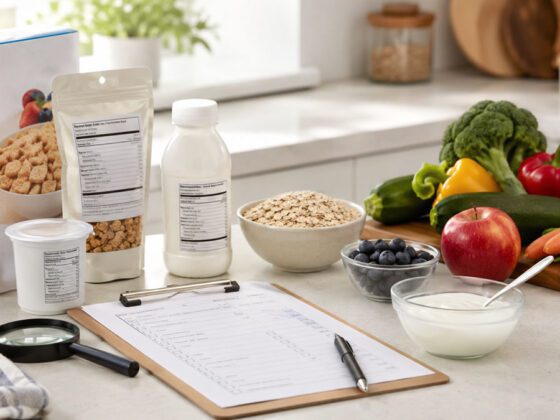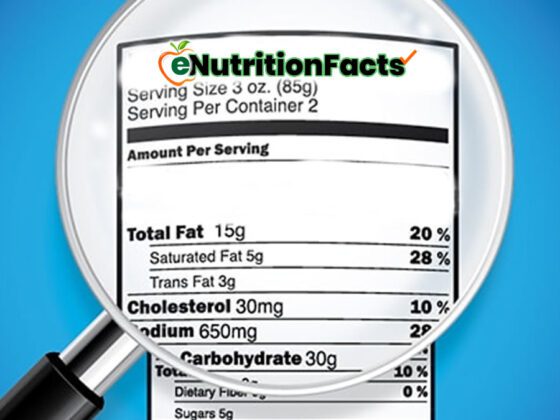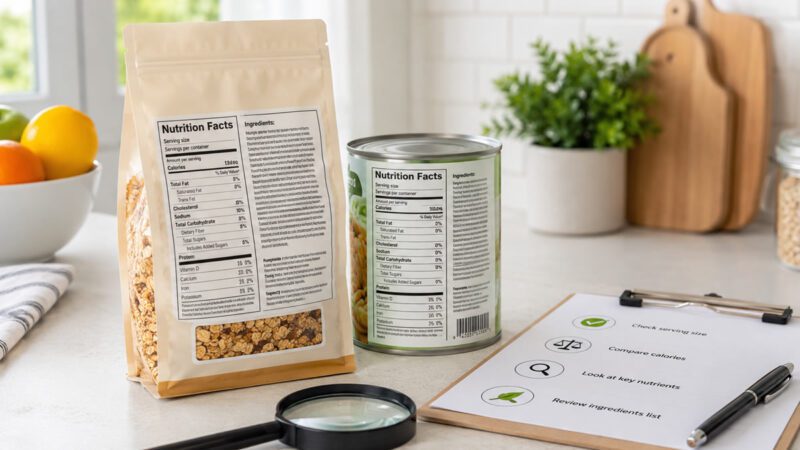
Nutrition Facts labels can look simple at first, but they contain several pieces of information that need to be read together. Serving size, calories, nutrients, percent Daily Value, added sugars, sodium, and ingredients all help explain what a packaged food provides per serving.
This guide explains how to read Nutrition Facts labels step by step. It is designed for practical food-label literacy, not medical advice or strict food rules.
Start With the Serving Size
Contents
- 1 Start With the Serving Size
- 2 Check Servings Per Container
- 3 Read Calories in Context
- 4 Understand % Daily Value
- 5 Look at Macronutrients
- 6 Check Sodium Carefully
- 7 Check Added Sugars
- 8 Read Vitamins and Minerals
- 9 Use the Ingredient List
- 10 Be Careful With Front-of-Pack Claims
- 11 Compare Similar Products Side by Side
- 12 Simple Nutrition Label Checklist
- 13 Common Nutrition Label Mistakes
- 14 How This Connects to Ingredient Labels and Clean Label Claims
- 15 Common Mistakes
- 16 Frequently Asked Questions
- 16.1 What does how to read nutrition facts labels mean on a Nutrition Facts label?
- 16.2 Why does serving size matter for how to read nutrition facts labels?
- 16.3 How should I compare how to read nutrition facts labels between products?
- 16.4 Is how to read nutrition facts labels enough to judge a food by itself?
- 16.5 Where should I start when reading the label?
- 17 Bottom Line
- 18 Sources and Methodology
Serving size is the first thing to check because the rest of the Nutrition Facts label is based on that amount. Calories, protein, fat, carbohydrates, sodium, fiber, added sugars, vitamins, and minerals are usually listed per serving.
This means a package can look lower or higher in calories and nutrients depending on the serving size used. If you eat two servings, the calories and listed nutrients are usually doubled. If you eat half a serving, they are usually reduced by half.
Serving size is not always the amount a person should eat. It is the amount used for the label calculation. For practical label reading, compare the listed serving size with the amount you actually plan to eat.
Check Servings Per Container
Servings per container tells you how many label servings are in the full package. This is important because some packages look like one portion but may contain more than one serving.
For example, if a package lists 200 calories per serving and contains two servings, the full package would provide about 400 calories if the entire package is eaten. The same logic applies to sodium, added sugar, fat, carbohydrates, protein, and other nutrients.
Read Calories in Context
Calories show the amount of energy provided by one serving of the food. Calories are useful, but they do not describe the full quality or composition of a food by themselves.
Two foods can have similar calories but different amounts of protein, fiber, added sugar, sodium, saturated fat, vitamins, minerals, and ingredients. This is why calories should be read together with the rest of the label.
Understand % Daily Value
Percent Daily Value, usually shown as %DV, helps estimate how much one serving contributes to a daily reference amount for a nutrient. It is based on general daily values, often using a 2,000-calorie daily diet as a reference.
A simple FDA label-reading rule is that 5% Daily Value or less is considered low for a nutrient per serving, while 20% Daily Value or more is considered high. This rule can help you quickly compare similar products.
For a deeper explanation, read our guide on what Percent Daily Value means on a Nutrition Facts label.
| % Daily Value | Plain-English Meaning | How to Use It |
|---|---|---|
| 5% DV or less | Low amount of that nutrient per serving | Useful when looking for lower sodium, lower saturated fat, or lower added sugar options. |
| Around 10% DV | Moderate amount per serving | Helpful for comparing similar products side by side. |
| 20% DV or more | High amount of that nutrient per serving | Useful when looking for more fiber, calcium, iron, potassium, or other nutrients of interest. |
The %DV is a general guide, not a personal prescription. Individual needs can vary by age, body size, activity level, health status, and dietary pattern.
Look at Macronutrients
Macronutrients are nutrients the body uses in larger amounts. On most Nutrition Facts labels, the main macronutrient sections are fat, carbohydrate, and protein.
Total Fat and Saturated Fat
Total fat shows the grams of fat in one serving. The label may also list saturated fat and sometimes trans fat. For label comparison, it is usually more helpful to compare similar foods rather than judge one number in isolation.
For example, comparing two crackers, two frozen meals, or two yogurts can show which one has more saturated fat per serving. Always check the serving size before comparing.
Total Carbohydrate, Fiber, and Sugars
Total carbohydrate includes starches, sugars, and fiber. Dietary fiber is listed separately because it is an important part of the carbohydrate section. Total sugars and added sugars may also be listed.
Added sugars are different from sugars naturally present in foods such as plain milk, fruits, or some vegetables. Added sugars are sugars added during processing or preparation, including ingredients such as sugar, syrups, honey, dextrose, sucrose, or concentrated fruit and vegetable juices used for sweetening.
Protein
Protein shows how many grams of protein are in one serving. This can be useful when comparing products such as yogurts, cereals, snacks, meat alternatives, protein bars, and ready meals.
A “high protein” claim on the front of a package should still be checked against the Nutrition Facts label and the serving size. Some products may provide protein but also contain higher amounts of added sugar, sodium, saturated fat, or other ingredients worth comparing.
Check Sodium Carefully
Sodium is listed in milligrams and as % Daily Value. It is one of the most useful nutrients to compare across packaged foods because similar products can vary widely.
When comparing products such as soups, sauces, frozen meals, breads, deli meats, snacks, or canned foods, check sodium per serving and make sure the serving sizes are similar. If one product uses a smaller serving size, it may look lower in sodium even if the real portion eaten is larger.
Check Added Sugars
Added sugars are listed separately from total sugars on many Nutrition Facts labels. This helps readers distinguish sugars added during processing from sugars naturally present in foods such as plain fruit or milk.
For label reading, check both grams and % Daily Value. A small-looking serving can still contain a meaningful amount of added sugar, especially in drinks, sweetened yogurts, cereals, snack bars, sauces, desserts, and flavored beverages.
Read Vitamins and Minerals
Nutrition Facts labels may list vitamins and minerals such as vitamin D, calcium, iron, and potassium. These values can help compare products, especially when the product is promoted for a specific nutrient.
As with other nutrients, the serving size matters. A product may look high in a vitamin or mineral because of the serving size, fortification, or both. Fortified foods can contribute nutrients, but the full ingredient list and overall nutrition profile should still be checked.
Use the Ingredient List
The Nutrition Facts panel tells you nutrient amounts. The ingredient list tells you what the food is made from. Both are useful.
Ingredients are usually listed in descending order by weight. This means the first ingredients generally make up the largest part of the product. If sugar, refined starches, oils, or other concentrated ingredients appear near the beginning, that can tell you something about the product composition.
The ingredient list can also help identify sweeteners, oils, additives, preservatives, colors, flavorings, allergens, and ingredient substitutions. It is especially useful when comparing products that look similar on the front of the package.
Be Careful With Front-of-Pack Claims
Front-of-pack claims can be useful, but they are not the whole label. Claims such as “natural,” “high protein,” “low fat,” “no added sugar,” “plant-based,” “keto,” “clean,” or “made with whole grains” should be checked against the Nutrition Facts panel and ingredient list.
For example, a product can be low in fat but higher in added sugar. A product can be high in protein but also high in sodium. A product can be plant-based but still contain refined ingredients, additives, or high levels of saturated fat depending on the formulation.
Compare Similar Products Side by Side
Nutrition labels are most useful when comparing similar foods. Comparing a cereal with another cereal, a yogurt with another yogurt, or a frozen meal with another frozen meal gives better context than looking at one product alone.
When comparing, check that the serving sizes are similar. Then compare the nutrients that matter for the specific food category, such as added sugars in cereal, sodium in soup, fiber in bread, protein in yogurt, or saturated fat in frozen meals.
Simple Nutrition Label Checklist
- Start with serving size.
- Check servings per container.
- Read calories in context, not alone.
- Use % Daily Value to identify low or high nutrient amounts.
- Compare added sugars, sodium, fiber, protein, and saturated fat when relevant.
- Read the ingredient list to understand what the food is made from.
- Check front-of-pack claims against the full label.
- Compare similar products using similar serving sizes.
Common Nutrition Label Mistakes
One common mistake is ignoring serving size. Another is reading calories without checking protein, fiber, added sugars, sodium, and ingredients. A third mistake is trusting the front of the package without reading the full label.
It is also easy to compare products unfairly when serving sizes are different. A smaller listed serving can make calories, sodium, sugar, or fat look lower than they would be in the amount actually eaten.
How This Connects to Ingredient Labels and Clean Label Claims
Nutrition label reading is the foundation for understanding packaged foods. It connects directly to ingredient-list interpretation, clean-label claims, ultra-processed food classification, food additives, sweeteners, and product comparisons.
For ingredient-focused guidance, visit our Clean Label & Ingredients category. For an example of food processing classification, read What Are Ultra-Processed Foods? The NOVA Classification Explained.
Common Mistakes
- Reading one label number without checking serving size first.
- Comparing two products that use different serving weights or serving amounts.
- Trusting a front-of-pack claim without checking the full Nutrition Facts label and ingredient list.
Frequently Asked Questions
What does how to read nutrition facts labels mean on a Nutrition Facts label?
How to read nutrition facts labels is a label value that should be read with serving size, % Daily Value when shown, and the rest of the Nutrition Facts panel.
Why does serving size matter for how to read nutrition facts labels?
The label values usually apply to one listed serving. If the amount eaten changes, the amount of how to read nutrition facts labels changes too.
How should I compare how to read nutrition facts labels between products?
Compare similar products using similar serving sizes, then check the grams or milligrams and % Daily Value when available.
Is how to read nutrition facts labels enough to judge a food by itself?
No. A single label value is only one part of the full food label. Serving size, ingredients, other nutrients, and the food category also matter.
Where should I start when reading the label?
Start at the top with serving size, then read calories, nutrients, % Daily Value, and the ingredient list together.
Bottom Line
To read a Nutrition Facts label clearly, start with serving size, then check calories, nutrients, % Daily Value, and the ingredient list. No single number tells the full story.
The most useful approach is to compare similar products, check serving sizes, read added sugars and sodium carefully, and use the ingredient list to understand what the food is made from.
Sources and Methodology
This article is based on U.S. Food and Drug Administration educational guidance on understanding and using the Nutrition Facts label, including serving size, calories, percent Daily Value, added sugars, and label-reading principles.
This article is for educational and informational purposes only and is not medical advice. Nutrition labels can help with food comparison, but individual nutrition needs may vary.