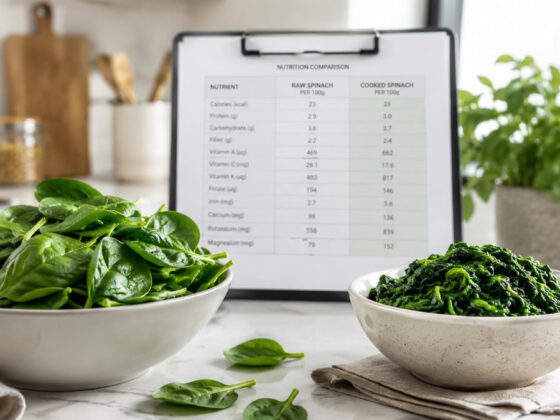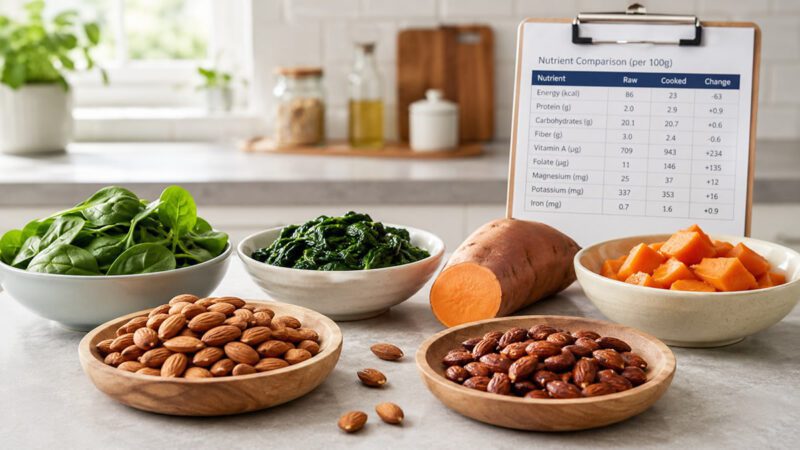
Bottom line: Cooking can change how nutrition facts are measured by altering food weight, water content, serving size, and the data entry used. Raw and cooked entries may not be directly comparable unless the same serving basis is used, such as 100 grams, one cup, or a clearly defined prepared serving.
How Cooking Changes Nutrition Facts
Cooking changes more than the taste and texture of food. It can also change how nutrition facts are measured, reported, and compared. A food that appears simple in a nutrition table may have different values depending on whether it is raw, cooked, boiled, steamed, roasted, air-fried, dehydrated, freeze-dried, drained, peeled, or measured by weight instead of volume.
This article explains the main reasons cooking can change nutrition facts without turning the topic into medical advice. The goal is practical food-data literacy: helping you understand why raw and cooked values may not match, why serving size matters, and why source notes should be checked before comparing foods.
Why raw and cooked nutrition entries may not match
Raw and cooked foods are often listed separately in nutrition databases because preparation changes the food itself. Cooking may change water content, food weight, texture, volume, and serving size. Because of that, a raw nutrition entry and a cooked nutrition entry may describe two different measurement situations, even when the food name looks similar.
For example, a raw vegetable measured by the cup may not weigh the same as the same vegetable after cooking. A cooked grain may absorb water and weigh more than the dry version. A dehydrated fruit may weigh less after water is removed. These changes affect how nutrition facts should be interpreted.
Food weight, water content, and values per serving
One of the biggest reasons cooking changes nutrition facts is water. Some foods lose water during cooking, while others absorb water. When water content changes, the final weight of the food can also change. This can make nutrition facts look different per 100 grams, per cup, or per prepared serving, even when the food itself is still the same basic ingredient.
This does not automatically mean one version of a food is better than another. It means the comparison needs context. A useful nutrition comparison should make the serving basis clear and explain whether the values come from raw data, cooked data, product-label data, or an estimate.
Raw vs Cooked Nutrition Data
Why 100 grams raw is not always equal to 100 grams cooked
A 100-gram comparison can be helpful because it uses the same weight on both sides. However, 100 grams raw and 100 grams cooked may not represent the same original amount of food. Cooking can change weight by removing or adding water, and that can make the cooked version look different depending on the food and method used.
For this reason, raw vs cooked nutrition comparisons should explain the basis of the data. If the article compares 100 grams raw with 100 grams cooked, the reader should understand that both are equal final weights, not necessarily equal starting amounts.
For a practical example, see our comparison of raw vs cooked spinach nutrition facts, where serving weight and cup measurements can change how the data appears.
Why one cup can change after cooking
Cup measurements can be convenient, but they are less precise than weight-based measurements. One cup of a raw food may have a very different weight from one cup of the same food after cooking. Chopping, packing, draining, peeling, and cooking can all change how much food fits into a cup.
This is why a cup-based comparison should be read carefully. When possible, eNutritionFacts articles explain whether the serving is measured raw, cooked, chopped, packed, drained, or prepared another way.
When raw data is more useful
Raw nutrition data is useful when the food is commonly eaten raw or when the reader wants to understand the starting point before preparation. It can also help when comparing fresh foods before they are cooked, mixed, drained, or seasoned.
Raw data can be especially helpful for foods such as fresh fruits, salad vegetables, raw nuts, seeds, or foods that are often measured before cooking. Still, raw data should not be treated as interchangeable with cooked data unless the serving basis is clearly explained.
When cooked data is more useful
Cooked nutrition data is more useful when the food is normally eaten after preparation. Many grains, legumes, meats, vegetables, and prepared dishes are more practical to compare in their cooked form because that is how they appear on the plate.
Cooked data can also be more useful when the question is about a prepared serving, such as boiled sweet potato per 100 grams, steamed broccoli per cup, or air-fried chicken breast. In those cases, the cooked form is usually the serving readers are trying to understand.
How Different Preparation Methods Affect Food Data
Boiling and water contact
Boiling places food in direct contact with water. Depending on the food and how it is measured, boiling may change the final weight, texture, and water content. Some nutrition entries may also differ depending on whether the food is measured with or without cooking liquid.
When reading boiled-food nutrition facts, check whether the values are based on drained food, cooked food with liquid, or a specific prepared serving. This is especially important for foods such as pasta, rice, legumes, potatoes, and vegetables.
Steaming and moisture-based cooking
Steaming uses heat and moisture without fully submerging food in water. From a nutrition-data perspective, the important question is not whether steaming is automatically preferable, but whether the article clearly states the serving basis and source entry used.
A steamed food entry may differ from a raw entry because the final food may have a different weight, texture, and volume. When comparing steamed foods, check whether the serving is listed by cup, grams, pieces, or another prepared serving.
Roasting and baking with dry heat
Roasting and baking use dry heat. These methods may reduce moisture in some foods, change texture, and change flavor. They may also involve added ingredients such as oil, butter, sauces, seasoning blends, or coatings, which can change final nutrition values.
When comparing roasted or baked foods, check whether the nutrition facts refer to the plain cooked food or a prepared version with added ingredients. A plain roasted vegetable and a roasted vegetable cooked with oil may not have the same nutrition profile.
Air frying and added-oil differences
Air frying cooks food with hot air circulation. The final nutrition values can vary depending on the food, portion size, breading, coating, and amount of added oil. Air-fried food should not be compared only by cooking method; the ingredients and serving basis also matter.
For air-fried foods, a clear nutrition article should explain whether the values are based on plain food, breaded food, frozen prepared food, added oil, or a specific product label. These details can make a large difference in how the nutrition facts should be read.
Dehydrating and freeze-drying
Dehydrating and freeze-drying remove moisture from food. This can make the food lighter and change how a serving should be interpreted. A small portion of dried fruit, for example, may represent a different amount of original fresh fruit than the same weight of fresh fruit.
When comparing dehydrated, dried, or freeze-dried foods, check the serving size carefully. A 100-gram dried serving and a 100-gram fresh serving may not represent the same amount of original food because the water content is different.
Serving Size Is the Hidden Variable
Weight-based servings vs cup-based servings
Weight-based servings, such as 100 grams or one ounce, are often easier to compare because the amount is clearly defined. Cup-based servings can still be useful, but they may vary depending on how the food is cut, packed, cooked, or drained.
For accurate comparisons, check whether the nutrition facts use grams, cups, ounces, pieces, slices, or label servings. If two foods use different serving bases, the comparison may be less useful until the portions are converted or explained.
Drained, peeled, chopped, packed, and cooked measurements
Preparation details can change the meaning of a serving. A peeled fruit may not match an unpeeled entry. A drained canned food may not match a food measured with liquid. A chopped cup may not match a packed cup. A cooked serving may not match a raw serving.
This is why eNutritionFacts articles aim to describe the data basis clearly. A nutrition table should help readers understand what was measured, not just display numbers without context.
Why product labels may differ from database entries
Product labels may differ from database entries because branded foods have specific ingredients, formulas, serving sizes, and preparation instructions. Manufacturers may also update products over time. A generic database entry and a branded product label should not always be treated as the same thing.
For branded products, the product label or manufacturer data may be more relevant than a generic food database entry. For whole foods, public food databases may be more useful. You can read more about how eNutritionFacts handles source selection in our Nutrition Data Methodology.
How to Compare Nutrition Facts More Accurately
Compare the same serving basis
Before comparing nutrition facts, check whether both foods use the same serving basis. A 100-gram comparison is different from a one-cup comparison. A raw serving is different from a cooked serving. A branded product label may not match a generic database entry.
The cleanest comparison usually starts by asking one question: are these values describing the same amount of food in the same prepared state? If not, the numbers may still be useful, but they need explanation.
Check whether the data is raw, cooked, branded, or estimated
Nutrition values can come from different sources. Some entries describe raw foods. Others describe cooked foods. Some come from branded product labels. Others may be estimated from available data. Each source type has a different use case.
A clear nutrition article should identify the data source and explain whether values are raw, cooked, branded, estimated, or based on a specific serving. This helps readers compare nutrition facts without assuming that every table uses the same measurement method.
Read source notes before comparing foods
Source notes are important because they explain where the data came from and how the serving was interpreted. A source note may tell you whether the food was raw or cooked, whether the serving was 100 grams or one cup, and whether the values came from a database, label, manufacturer, or estimate.
If a nutrition comparison does not explain the source or serving basis, treat it cautiously. The numbers may still be useful, but they are easier to misunderstand.
What Can Change When Food Is Prepared?
| Factor | What changes | Why it matters for nutrition facts | Example |
|---|---|---|---|
| Water content | May decrease or increase depending on the method | Can change food weight and values per serving | Boiled, steamed, dehydrated, or cooked grains |
| Food weight | May change after cooking or drying | Affects comparisons based on 100 grams or one cup | Raw vegetables compared with cooked vegetables |
| Serving size | May vary by raw, cooked, chopped, packed, or drained form | Can make two nutrition tables look different even for the same food | One cup raw spinach vs one cup cooked spinach |
| Added ingredients | Oil, butter, sauces, coatings, or seasonings may be added | Changes the final nutrition values beyond the food itself | Plain baked potato vs potato prepared with oil |
| Raw vs cooked data entry | Different database entries may be used | Raw and cooked entries may not describe the same prepared state | Raw broccoli entry vs steamed broccoli entry |
| Brand or product label | Values may vary by formula, serving size, and manufacturer updates | Generic food data may not match a branded product | Store-brand frozen meal or packaged snack |
Preparation Method Comparison
| Preparation method | Common data issue | What readers should check |
|---|---|---|
| Raw | May not match how the food is usually eaten | Check whether the article compares raw or prepared food |
| Boiled | Water contact and draining can affect the final serving | Check whether values are for drained food or food with liquid |
| Steamed | Cooked volume and weight may differ from raw food | Check whether the serving is measured by cup, grams, or pieces |
| Roasted or baked | Moisture changes and added ingredients may affect values | Check whether oil, sauces, or coatings are included |
| Air-fried | Final values may depend on breading, coating, and added oil | Check whether the data is for plain, breaded, frozen, or oiled food |
| Dehydrated | Water removal changes weight and serving interpretation | Check serving size and compare with fresh weight carefully |
| Freeze-dried | Water removal changes weight and portion interpretation | Check whether the comparison uses dried weight or original fresh weight |
Recommended Comparison Basis
| Comparison type | Recommended serving basis | Why |
|---|---|---|
| Raw vs cooked vegetables | 100 grams plus a practical cup serving when available | Shows both a precise weight comparison and a real-life serving context |
| Cooked grains | Cooked weight or prepared cup serving | Dry and cooked weights can differ because grains absorb water |
| Nuts and seeds | Ounces, grams, tablespoons, or label serving | Small portion changes can affect how values are interpreted |
| Air-fried foods | Prepared serving with ingredient notes | Added oil, coating, or breading can change final nutrition values |
| Dehydrated fruits | Label serving and gram weight | Dried portions may represent a different amount of original fruit than the same weight of fresh fruit |
| Branded products | Product label serving | Brand formulas, serving sizes, and labels can change over time |
Examples Covered in This Category
Raw vs cooked spinach
A raw vs cooked spinach article should explain the serving basis clearly. One cup of raw spinach and one cup of cooked spinach can represent different weights and volumes, so the comparison should not rely on the cup measurement alone.
Boiled sweet potato per 100g
A boiled sweet potato nutrition article should explain whether the values are based on 100 grams of the cooked food, a typical serving, or another measurement. This helps readers avoid confusing raw weight with cooked weight.
Steamed broccoli per cup
A steamed broccoli article should clarify whether the nutrition facts use one cup, 100 grams, or another serving size. If the article compares raw and steamed broccoli, it should explain that the prepared state and serving basis matter.
Raw vs roasted almonds
A raw vs roasted almonds article should state whether the roasted almonds are dry-roasted, oil-roasted, salted, unsalted, or flavored. These preparation details can affect how the final nutrition facts should be interpreted.
Air-fried chicken breast
An air-fried chicken breast article should explain whether the nutrition values are for plain chicken breast, breaded chicken, frozen prepared chicken, or chicken cooked with added oil. The preparation details are part of the nutrition context.
Key Takeaways
Cooking can change how nutrition facts are measured because preparation can affect water content, food weight, serving size, and the data entry used. Raw and cooked foods are not always directly comparable unless the article clearly explains the serving basis and prepared state.
A clearer way to compare nutrition facts is to check whether the food is raw, cooked, branded, estimated, drained, peeled, chopped, packed, or prepared with added ingredients. Always read source notes before assuming two nutrition tables describe the same thing.
You can explore more preparation-focused articles in the Preparation Impact category. You can also review how eNutritionFacts handles nutrition data in our Nutrition Data Methodology, how we create and review content in our Editorial Guidelines, and how to report possible updates through our Corrections Policy.
Nutrition facts may vary by brand, preparation method, serving size, and data source. When possible, eNutritionFacts uses source-backed data such as USDA FoodData Central, product labels, manufacturer data, or clearly labeled estimates. Read our Nutrition Data Methodology.
Common Mistakes
- Comparing raw and cooked foods by cup without checking the cooked weight.
- Using a raw database entry for a cooked food, or a cooked entry for a raw food.
- Forgetting to count added oil, salt, sauces, cheese, or other ingredients separately.
Simple Checklist
- Check whether the food is raw, cooked, drained, roasted, canned, or recipe-based.
- Use 100 grams when a cleaner comparison is needed.
- Use cups carefully because volume and weight can change after preparation.
- Choose the database entry that matches the food form actually eaten.
- Count added ingredients separately when the database entry does not include them.
Frequently Asked Questions
Why can nutrition facts change after cooking?
Cooking can change water content, volume, food weight, and final yield, so the serving basis can change.
Should raw and cooked foods be compared by cup or by weight?
A weight-based comparison, such as 100 grams, is usually cleaner. Cup comparisons can be practical but may not be equal by weight.
Do added ingredients change the nutrition facts?
Yes. Oil, butter, salt, sauces, cheese, sugar, or other added ingredients should be counted separately unless the data entry includes them.
Which database entry should I use?
Use the entry that matches the food form actually eaten, such as raw, cooked, boiled, drained, roasted, canned, or recipe-based.
Sources and Methodology
This article should cite the canonical source for its topic, such as FDA guidance for nutrition label topics, USDA FoodData Central for nutrient data, or appropriate peer-reviewed/public-health sources for food science topics.