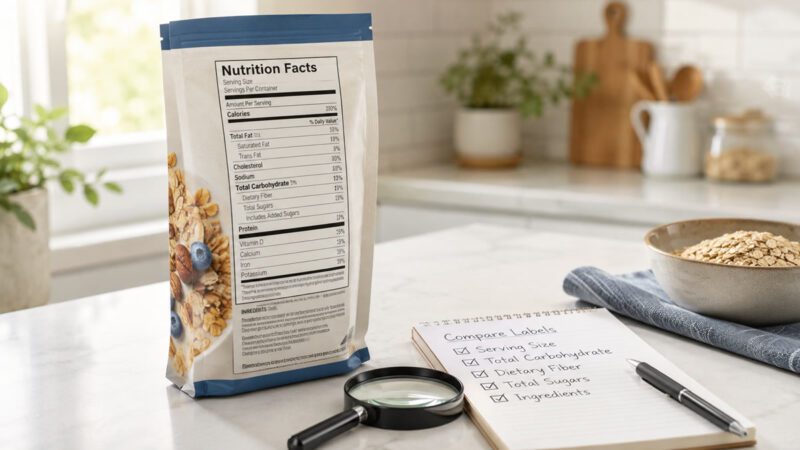
Total Carbohydrate on a Nutrition Facts label shows the total grams of carbohydrate in one listed serving of a food or drink. The number is measured in grams and includes the carbohydrate details shown underneath it, such as Dietary Fiber, Total Sugars, and Added Sugars when those lines appear. Starch can also contribute to Total Carbohydrate, even when starch is not displayed as its own separate label line. To read this part of the label clearly, start with serving size, then check the Total Carbohydrate grams, the Percent Daily Value, the carbohydrate sub-lines, and the ingredient list. This makes the number useful for comparing similar packaged foods without turning it into a personal nutrition target or medical rule.
This guide explains how to read the Total Carbohydrate line as a label-reading tool. It does not tell you how much carbohydrate you personally should eat, and it should not be used as a medical or personalized diet plan.
What Total Carbohydrate Means on the Label
Contents
- 1 What Total Carbohydrate Means on the Label
- 2 Where Total Carbohydrate Appears on the Nutrition Facts Label
- 3 What Is Included Under Total Carbohydrate?
- 4 Total Carbohydrate Is Not the Same as Total Sugars
- 5 Why Serving Size Matters
- 6 How % Daily Value Helps Comparison
- 7 How to Compare Two Products
- 8 Common Total Carbohydrate Label Mistakes
- 9 Simple Total Carbohydrate Checklist
- 10 FAQ
- 11 Sources and Methodology
Total Carbohydrate is the main carbohydrate line on the Nutrition Facts panel. It gives the total carbohydrate amount in one serving, usually written in grams. This number is a total, not a separate food-quality score.
The word “total” matters because the number can include different carbohydrate types that are listed in more detail below it. Depending on the food, those sub-lines may include Dietary Fiber, Total Sugars, Added Sugars, and sometimes other carbohydrate-related details required or allowed by label rules.
A practical way to read the line is to ask: “How many grams of total carbohydrate are in the serving shown at the top of this label?” After that, read the lines below Total Carbohydrate to understand the mix of fiber and sugars.
Where Total Carbohydrate Appears on the Nutrition Facts Label
On most Nutrition Facts labels, Total Carbohydrate appears in the main nutrient section, near other major nutrient lines. It is usually shown after sodium and before dietary fiber and sugars. The exact visual spacing can vary by label format, but the meaning stays the same: the value applies to the listed serving size.
For the full step-by-step label-reading process, start with How to Read Nutrition Facts Labels. That guide explains why the top of the panel, especially serving size and servings per container, should be checked before reading individual nutrient lines.
What Is Included Under Total Carbohydrate?
The Total Carbohydrate number includes the carbohydrate amount declared for one serving. The label then breaks out some parts of that total so readers can compare foods more clearly. The most common sub-lines are Dietary Fiber, Total Sugars, and Added Sugars.
| Label line | Plain-English meaning | How to use it |
|---|---|---|
| Total Carbohydrate | Total grams of carbohydrate in one serving. | Use it as the main carbohydrate comparison number. |
| Dietary Fiber | The fiber amount listed within the carbohydrate section. | Read it as extra detail below Total Carbohydrate. |
| Total Sugars | The total sugar amount in one serving. | Use it with Added Sugars and the ingredient list. |
| Added Sugars | Sugars added during processing or preparation when declared on the label. | Compare it separately from Total Sugars. |
For a deeper look at the fiber line, read What Does Dietary Fiber Mean on a Nutrition Label?. For the added-sugar line, use What Does Added Sugar Mean on a Nutrition Label?.
Total Carbohydrate Is Not the Same as Total Sugars
One common mistake is reading Total Carbohydrate and Total Sugars as if they are the same number. They are related, but they are not the same label line. Total Sugars is one part of the carbohydrate section. Total Carbohydrate is the broader line.
For example, two products may have the same Total Carbohydrate amount but different fiber and sugar amounts. Another product may have a moderate Total Carbohydrate number but a higher Added Sugars line. This is why reading only one number can be misleading.
The better approach is to read the full carbohydrate block: Total Carbohydrate first, then Dietary Fiber, Total Sugars, Added Sugars, and finally the ingredient list for context.
Why Serving Size Matters
Nutrition Facts label values usually apply to one listed serving. If the serving size is one cup, the Total Carbohydrate number applies to one cup. If the serving size is one bar, the number applies to one bar. If someone eats more or less than the listed serving, the amount eaten changes with the portion.
This is why Total Carbohydrate should not be read before checking the top of the label. Serving size and servings per container explain what the numbers are based on. For a focused explanation, see What Does Serving Size Mean on a Nutrition Label?.
Serving size also matters when comparing two products. If one label uses a 30 g serving and another uses a 55 g serving, the carbohydrate numbers are not being shown on the same amount of food. In that case, compare similar serving sizes or use per-100 g data when available.
How % Daily Value Helps Comparison
The Percent Daily Value, often written as %DV, shows how much one serving contributes to a general daily reference amount. For Total Carbohydrate, the current U.S. Nutrition Facts label Daily Value is 275 g. The %DV turns the grams on the label into a comparison shortcut.
For example, if a product shows 10% Daily Value for Total Carbohydrate, one serving provides about one tenth of the general Daily Value used for labeling. This does not mean the food is right or wrong for every person. It simply makes similar products easier to compare.
The FDA’s label-education materials also use the general guide that 5% DV or less is low and 20% DV or more is high for a nutrient per serving. For more background, read What Does Percent Daily Value Mean on a Nutrition Label?.
How to Compare Two Products
When comparing two similar products, begin with serving size. If the serving sizes are similar, compare Total Carbohydrate grams and %DV. Then check the lines underneath Total Carbohydrate to see how much comes from fiber, total sugars, and added sugars.
The ingredient list can help explain why similar foods show different carbohydrate details. Whole-grain ingredients, fruit ingredients, sweeteners, syrups, starches, added fibers, and different recipes can all affect the carbohydrate block on the label.
Use the Nutrition Label Guides category for more plain-English label explanations. Each guide is meant to help readers compare labels without turning a single number into a personal nutrition rule.
Common Total Carbohydrate Label Mistakes
- Reading Total Carbohydrate before checking serving size.
- Assuming Total Carbohydrate and Total Sugars mean the same thing.
- Ignoring Dietary Fiber when comparing similar products.
- Ignoring Added Sugars when a label lists them below Total Sugars.
- Comparing two products with very different serving weights.
- Using a front-of-pack claim instead of checking the full Nutrition Facts label.
- Treating a general label reference as a personalized nutrition target.
Simple Total Carbohydrate Checklist
- Start with the serving size and servings per container.
- Find the Total Carbohydrate line.
- Read the amount in grams.
- Check the % Daily Value.
- Read the sub-lines for Dietary Fiber, Total Sugars, and Added Sugars.
- Use the ingredient list to understand the food context.
- Compare similar products using similar serving sizes.
- Use one label number as a clue, not the full answer.
FAQ
Does Total Carbohydrate include sugar?
Yes. Total Sugars are part of the broader Total Carbohydrate section. When Added Sugars are listed, they appear as a separate sub-line under Total Sugars.
Does Total Carbohydrate include dietary fiber?
Yes. Dietary Fiber is listed under Total Carbohydrate because it is part of the carbohydrate section on the Nutrition Facts label. The separate fiber line gives more detail about one part of the total.
Why can two products have the same Total Carbohydrate but different sugars?
Two foods can have the same Total Carbohydrate amount but different amounts of fiber, total sugars, or added sugars. This is why the full carbohydrate block matters more than one line by itself.
Should I compare Total Carbohydrate by serving size or per 100 g?
For packaged-food labels, start with the listed serving size because that is how the Nutrition Facts panel is presented. For research-style or database comparisons, per-100 g values can help compare equal weights when available.
Is %DV the same as a personal carbohydrate target?
No. %DV is a general label-reference tool. It helps compare foods, but it does not replace personalized guidance from a qualified professional when someone has individual nutrition needs.
Sources and Methodology
This article uses U.S. Food and Drug Administration Nutrition Facts label guidance to explain Total Carbohydrate, serving size, Daily Value, and Percent Daily Value as label-reading concepts. It is written as general food-label education, not as personalized dietary advice.
For more detail about how eNutritionFacts handles source-backed nutrition explanations, see our Nutrition Data Methodology and Expert Review Policy.
This article is for educational and informational purposes only and is not medical advice. Individual nutrition needs may vary. For personalized dietary guidance, consult a qualified professional. See the Medical Disclaimer.