Raw and cooked spinach can look very different in nutrition facts, especially when the comparison is made by cup. The main reason is that cooking changes spinach volume and final serving weight, so cup-based values can represent different amounts of food.
The sections below compare spinach in two ways: by 100 grams and by common cup-based serving sizes. These two views answer different questions. The 100g view is cleaner for data comparison, while the cup view is more practical for meals and recipes.
Per 100 grams, raw spinach and cooked, boiled, drained spinach are close in calories and macronutrients. The larger difference appears when comparing one cup of raw spinach with one cup of cooked, drained spinach, because cooking changes the volume and final serving weight.
- One cup of raw spinach is light and loosely packed.
- One cup of cooked, drained spinach can represent a different food weight than one cup of raw leaves.
- For nutrition data comparison, 100g is usually the cleaner baseline.
- For meal planning, cup measurements can still be useful, but they should be interpreted carefully.
Raw vs Cooked Spinach Nutrition Facts per 100g
Contents
- 1 Raw vs Cooked Spinach Nutrition Facts per 100g
- 2 Raw vs Cooked Spinach by Cup
- 3 Why Cooked Spinach Looks Different in Nutrition Tables
- 4 Which Entry Should You Use for Nutrition Tracking?
- 5 Raw Spinach vs Cooked Spinach: Practical Data Notes
- 6 How This Connects to Preparation Impact
- 7 Common Mistakes
- 8 Simple Checklist
- 9 Frequently Asked Questions
- 10 Bottom Line
- 11 Sources and Methodology
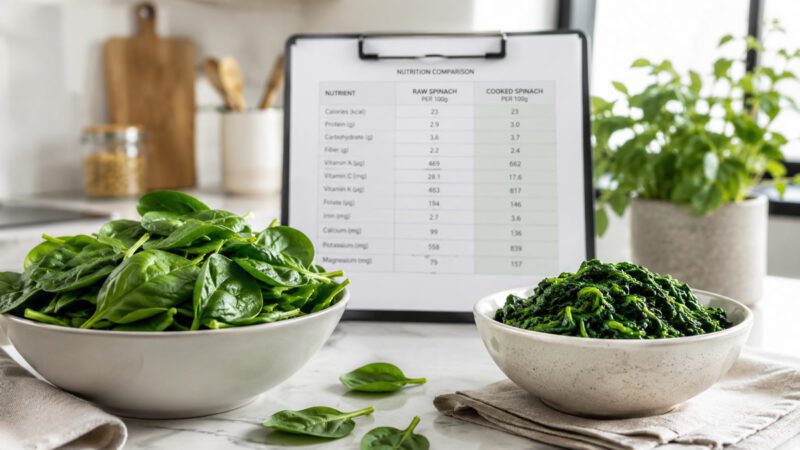
The table below compares raw spinach with cooked spinach that has been boiled and drained without added salt. This keeps the comparison focused on preparation method, not added ingredients.
| Nutrient | Raw spinach, 100g | Cooked spinach, boiled & drained, 100g |
|---|---|---|
| Calories | 23 kcal | 23 kcal |
| Protein | 2.86 g | 2.97 g |
| Total carbohydrate | 3.63 g | 3.75 g |
| Fiber | 2.2 g | 2.4 g |
| Fat | 0.39 g | 0.26 g |
| Calcium | 99 mg | 136 mg |
| Iron | 2.71 mg | 3.57 mg |
| Potassium | 558 mg | 466 mg |
When spinach is compared by the same weight, the values are easier to read side by side. This is why nutrition data should always be checked against the serving basis: raw weight, cooked weight, cup, grams, or recipe yield.
Raw vs Cooked Spinach by Cup
Cup comparisons can be helpful for everyday cooking, but they are not always equal comparisons. A cup of raw spinach weighs much less than a cup of cooked, drained spinach. This means the cooked cup may show different nutrition numbers mainly because the cup represents a different food weight.
| Nutrient | Raw spinach, 1 cup about 30g | Cooked spinach, 1 cup about 180g |
|---|---|---|
| Calories | 7 kcal | 41 kcal |
| Protein | 0.86 g | 5.3 g |
| Total carbohydrate | 1.1 g | 6.8 g |
| Fiber | 0.66 g | 4.3 g |
| Calcium | 29.7 mg | 244.8 mg |
| Iron | 0.81 mg | 6.4 mg |
| Potassium | 167.4 mg | 838.8 mg |
These cup-based numbers should not be read as a ranking between raw and cooked spinach. They mainly show that the serving basis is different. Raw leaves are usually measured loosely, while cooked, drained spinach has reduced volume after preparation.
Why Cooked Spinach Looks Different in Nutrition Tables
Spinach changes volume during cooking because heat softens the leaves and water is released. After boiling and draining, the same cup measurement may represent a different cooked weight than a loosely packed cup of raw spinach.
This is why cup-based nutrition numbers can look different. The comparison depends on how the serving is measured, not on a simple ranking between raw and cooked spinach.
Which Entry Should You Use for Nutrition Tracking?
For nutrition tracking, choose the database entry that matches the food form you actually eat. If you eat spinach raw in a salad, use a raw spinach entry. If you eat spinach boiled and drained, use a cooked, boiled, drained entry.
If the spinach is prepared with oil, butter, sauce, cheese, salt, or other ingredients, those ingredients should be counted separately. A plain cooked spinach entry usually does not include added fats, sauces, or seasonings unless the database entry clearly says so.
Raw Spinach vs Cooked Spinach: Practical Data Notes
- Use 100g when comparing raw and cooked spinach as food data entries.
- Use cup measurements when estimating a real serving, but remember that raw and cooked cups are not equal by weight.
- Choose the database entry that matches the preparation method: raw, boiled, drained, frozen, canned, sautéed, or recipe-based.
- Do not compare raw and cooked spinach without checking whether the data is based on grams, cups, or cooked yield.
How This Connects to Preparation Impact
Spinach is a useful example of why preparation method matters in nutrition facts. Cooking can change the weight, water content, volume, and serving basis of a food. Those changes can make a nutrition table or database entry look different, even when the same basic ingredient is being compared.
For a broader explanation, read our guide to how cooking changes nutrition facts. You can also explore more articles in the Preparation Impact category.
Common Mistakes
- Comparing raw and cooked foods by cup without checking the cooked weight.
- Using a raw database entry for a cooked food, or a cooked entry for a raw food.
- Forgetting to count added oil, salt, sauces, cheese, or other ingredients separately.
Simple Checklist
- Check whether the food is raw, cooked, drained, roasted, canned, or recipe-based.
- Use 100 grams when a cleaner comparison is needed.
- Use cups carefully because volume and weight can change after preparation.
- Choose the database entry that matches the food form actually eaten.
- Count added ingredients separately when the database entry does not include them.
Frequently Asked Questions
Why can nutrition facts change after cooking?
Cooking can change water content, volume, food weight, and final yield, so the serving basis can change.
Should raw and cooked foods be compared by cup or by weight?
A weight-based comparison, such as 100 grams, is usually cleaner. Cup comparisons can be practical but may not be equal by weight.
Do added ingredients change the nutrition facts?
Yes. Oil, butter, salt, sauces, cheese, sugar, or other added ingredients should be counted separately unless the data entry includes them.
Which database entry should I use?
Use the entry that matches the food form actually eaten, such as raw, cooked, boiled, drained, roasted, canned, or recipe-based.
Bottom Line
Raw and cooked spinach are both valid nutrition data entries, but they should not be compared blindly by cup. Per 100g, the values are easier to compare. Per cup, cooked, drained spinach can show different numbers because the cup measurement does not represent the same food weight as a loosely packed raw cup.
For the clearest nutrition tracking, match the data entry to the way the spinach is prepared and check whether the serving is listed by grams, cup, or cooked yield.
Sources and Methodology
Nutrition values in this article are based on USDA FoodData Central-style food composition data for raw spinach and cooked spinach that is boiled, drained, and prepared without added salt. Values may vary by spinach variety, growing conditions, database entry, cooking time, draining method, and serving measurement.
This article is for educational and informational purposes only and is not medical advice.