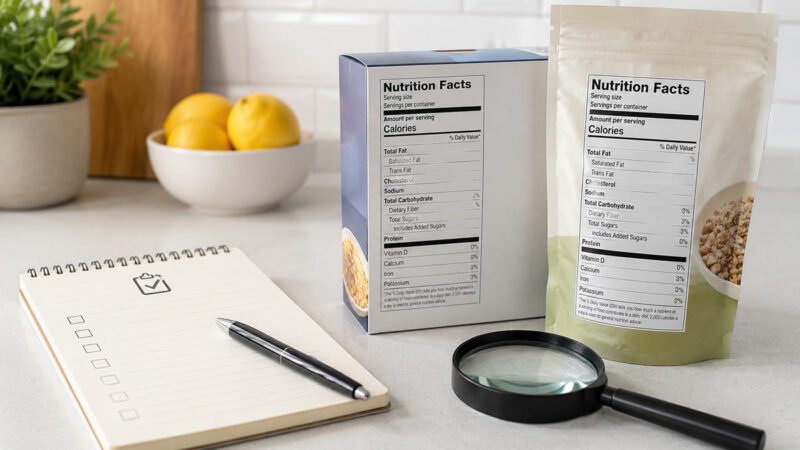
Dietary fiber on a Nutrition Facts label shows how much fiber is in one serving of a food. It is listed in grams and usually appears with Percent Daily Value, so readers can compare similar products using the same serving basis.
This guide explains what dietary fiber means on food labels, where to find it, how it relates to Total Carbohydrate, how serving size affects the number, and how to use % Daily Value without turning a label into personal medical advice.
What Is Dietary Fiber on a Nutrition Facts Label?
Contents
- 1 What Is Dietary Fiber on a Nutrition Facts Label?
- 2 Where Dietary Fiber Appears on the Label
- 3 How Dietary Fiber Relates to Total Carbohydrate
- 4 Why Serving Size Matters for Dietary Fiber
- 5 What Does % Daily Value Mean for Dietary Fiber?
- 6 How to Compare Dietary Fiber Between Products
- 7 Dietary Fiber Claims on Packages
- 8 Common Dietary Fiber Label Mistakes
- 9 Simple Dietary Fiber Label Checklist
- 10 How This Connects to Nutrition Label Reading
- 11 FAQ
- 12 Bottom Line
- 13 Sources and Methodology
Dietary fiber is a carbohydrate-related line on the Nutrition Facts label. On most labels, it is listed in grams under Total Carbohydrate. The number tells you how many grams of dietary fiber are in one serving of that food.
For example, if a cereal label lists 5 g dietary fiber, that means one serving of that cereal provides 5 grams of dietary fiber. If the serving size is one cup, the 5 grams apply to one cup. If someone eats two cups, the fiber amount would be about double, assuming the same food and serving basis.
The label number is a comparison tool. It helps readers compare similar foods, such as breads with breads, cereals with cereals, bars with bars, or snacks with snacks. It is not a personalized target for every person.
Where Dietary Fiber Appears on the Label
Dietary fiber usually appears under the Total Carbohydrate section of the Nutrition Facts label. This placement matters because fiber is counted within total carbohydrate, but it is shown separately so readers can see more detail.
| Label Line | Plain-English Meaning | How to Use It |
|---|---|---|
| Total Carbohydrate | The total amount of carbohydrate in one serving. | Use it as the broader carbohydrate line on the label. |
| Dietary Fiber | The amount of fiber included within that serving. | Use it to compare fiber between similar foods. |
| Total Sugars / Added Sugars | Sugar lines shown separately from fiber. | Read these separately instead of assuming all carbohydrates are the same. |
This is why a food can have Total Carbohydrate, Dietary Fiber, Total Sugars, and Added Sugars on the same label. These lines are related, but they are not interchangeable.
How Dietary Fiber Relates to Total Carbohydrate
Dietary fiber is part of the broader carbohydrate section on the Nutrition Facts label. When reading the label, start with the serving size, then look at Total Carbohydrate, then check the dietary fiber line for more detail.
A higher Total Carbohydrate number does not automatically tell you whether a food has more fiber. Two similar products may have similar total carbohydrate values but different fiber amounts. This is why the separate dietary fiber line is useful.
For label comparison, avoid judging the product from one number alone. A more practical approach is to compare serving size, Total Carbohydrate, Dietary Fiber, Added Sugars, sodium, protein, and the ingredient list together.
Why Serving Size Matters for Dietary Fiber
Nutrition Facts values are based on the listed serving size. That means the dietary fiber value is not always for the full package, full box, full bottle, or full recipe. It is normally for one serving.
If a label lists 4 g dietary fiber per serving and the package contains two servings, eating the whole package would provide about 8 g dietary fiber. If someone eats half of the listed serving, the amount would be about 2 g.
This is one of the most common label-reading mistakes. A product may look high or low in fiber until the serving size is checked. For a deeper explanation, read What Does Serving Size Mean on a Nutrition Label?.
What Does % Daily Value Mean for Dietary Fiber?
Percent Daily Value shows how much one serving contributes to a general daily reference amount. For dietary fiber, the Nutrition Facts label may show both grams and % Daily Value.
A simple label-reading rule is that 5% Daily Value or less is considered low per serving, while 20% Daily Value or more is considered high per serving. This rule is useful for comparing similar products, not for giving personal nutrition advice.
| Fiber %DV | Plain-English Meaning | How to Use It |
|---|---|---|
| 5% DV or less | Low fiber per serving. | Useful when comparing products with similar serving sizes. |
| 6% to 19% DV | Middle range per serving. | Compare with similar foods and check the ingredient list. |
| 20% DV or more | High fiber per serving. | Notice it as a meaningful label signal, while still checking serving size. |
For more background on this label tool, read What Does Percent Daily Value Mean on a Nutrition Label?.
How to Compare Dietary Fiber Between Products
Dietary fiber comparison works best when products are similar. Compare bread with bread, cereal with cereal, pasta with pasta, crackers with crackers, or snack bars with snack bars. Comparing completely different foods can be less useful because serving sizes and food roles may differ.
First, check whether the serving sizes are similar. If one cereal lists fiber for 30 grams and another lists fiber for 55 grams, the second product may appear higher simply because the serving is larger.
Second, check both grams and % Daily Value. The gram amount tells you the actual fiber in one serving. The % Daily Value helps show how that amount fits into the general Daily Value used on labels.
Third, use the ingredient list. Whole grains, beans, lentils, peas, nuts, seeds, fruits, vegetables, bran, and added fiber ingredients may all affect the fiber amount. The ingredient list helps explain where the label number may come from.
Dietary Fiber Claims on Packages
Some packages use front-of-pack claims such as “good source of fiber,” “excellent source of fiber,” or “high fiber.” These claims can be helpful, but the Nutrition Facts label should still be checked.
The front claim is not the full picture. Serving size, grams of fiber, % Daily Value, added sugars, sodium, saturated fat, protein, and ingredient context can all matter when comparing similar products.
A practical rule is simple: use the front claim as a prompt to check the back or side label, not as the final answer.
Common Dietary Fiber Label Mistakes
- Reading dietary fiber without checking serving size first.
- Assuming the fiber number applies to the whole package.
- Comparing two products with very different serving weights.
- Confusing Total Carbohydrate with dietary fiber.
- Assuming a front-of-pack fiber claim tells the full story.
- Ignoring added sugars, sodium, saturated fat, or ingredient context when comparing products.
Simple Dietary Fiber Label Checklist
- Start with the serving size.
- Find Dietary Fiber under Total Carbohydrate.
- Read the amount in grams.
- Check the % Daily Value.
- Use 5% DV or less as low and 20% DV or more as high per serving.
- Compare similar foods using similar serving sizes.
- Use the ingredient list to understand where the fiber may come from.
- Check front-of-pack fiber claims against the full Nutrition Facts label.
How This Connects to Nutrition Label Reading
Dietary fiber is one part of the broader label-reading process. It should be read with serving size, Total Carbohydrate, Added Sugars, calories, sodium, protein, saturated fat, ingredients, and package claims.
For the full step-by-step label-reading framework, read How to Read Nutrition Facts Labels. You can also explore more articles in the Nutrition Label Guides category.
FAQ
Is dietary fiber included in Total Carbohydrate?
Yes. On the Nutrition Facts label, dietary fiber is listed under Total Carbohydrate because it is part of the broader carbohydrate section. The separate fiber line gives more detail about the type of carbohydrate in one serving.
Is more dietary fiber always better on a label?
Not automatically. A higher fiber number can be useful when comparing similar products, but the full label still matters. Serving size, ingredient list, added sugars, sodium, saturated fat, protein, and overall food context should also be checked.
What is a high fiber %DV?
For label reading, 20% Daily Value or more is generally considered high per serving. This is a comparison tool, not personal dietary guidance.
Why do two similar foods show different fiber amounts?
Different recipes, grains, legumes, nuts, seeds, fruit ingredients, added fibers, and serving sizes can change the dietary fiber value. This is why comparing similar serving sizes and checking the ingredient list is helpful.
Bottom Line
Dietary fiber on a Nutrition Facts label shows the grams of fiber in one serving and usually includes % Daily Value. It appears under Total Carbohydrate and should be read after checking serving size.
For practical comparison, use similar products, similar serving sizes, grams of fiber, % Daily Value, and the ingredient list together. Do not treat one label number as a personalized nutrition plan.
Sources and Methodology
This article is based on U.S. Food and Drug Administration educational guidance for the Nutrition Facts label, including serving-size interpretation, dietary fiber declaration, and Percent Daily Value label reading. eNutritionFacts uses these sources as label-literacy references rather than individualized nutrition advice.
For more detail about how eNutritionFacts handles source-backed nutrition explanations, see our Nutrition Data Methodology and Expert Review Policy.
This article is for educational and informational purposes only and is not medical advice. Individual nutrition needs may vary. For personalized dietary guidance, consult a qualified professional. See the Medical Disclaimer.