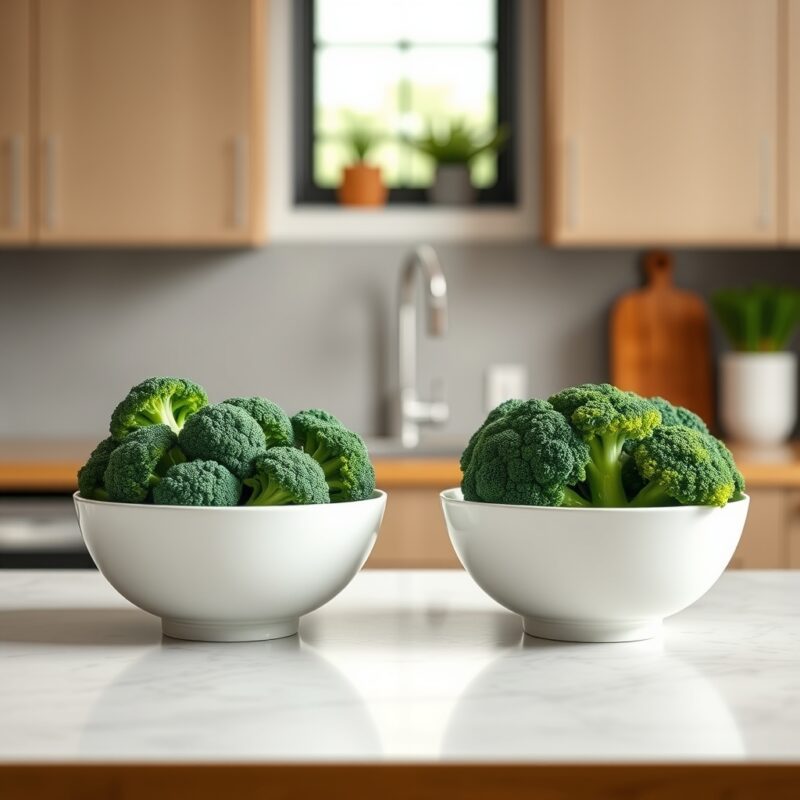
Raw and cooked broccoli can look similar at first glance, but preparation changes water content, cooked weight, texture, and nutrient density per 100 grams. That means a raw broccoli record and a cooked broccoli record should not be treated as the same food entry. The most useful comparison is to check the exact preparation method, compare values on the same weight basis, and read the numbers as preparation-specific nutrition data rather than as a ranking between raw and cooked forms.
Raw vs cooked broccoli nutrition comparison
Contents
- 1 Raw vs cooked broccoli nutrition comparison
- 2 Why cooking changes broccoli nutrition facts
- 3 Per-100g values are not the same as serving-size values
- 4 Cooking method matters
- 5 Common mistakes when comparing raw and cooked broccoli
- 6 Practical checklist for raw vs cooked nutrition data
- 7 How this helps with nutrition labels and data comparisons
- 8 FAQ
- 9 Sources and methodology
- 10 Educational disclaimer
The table below compares raw broccoli with boiled and drained cooked broccoli on a per-100g basis. This is the cleanest way to compare preparation forms because both columns use the same weight basis. It does not mean that 100g of raw broccoli becomes exactly 100g after cooking. Cooking can change the final weight through water loss, water absorption, and draining.
| Nutrient | Raw broccoli per 100g | Cooked broccoli, boiled and drained per 100g |
|---|---|---|
| Calories | 34kcal | 35kcal |
| Water | 89.3g | 89.3g |
| Protein | 2.8g | 2.4g |
| Total fat | 0.4g | 0.4g |
| Carbohydrate | 6.6g | 7.2g |
| Dietary fiber | 2.6g | 3.3g |
| Total sugars | 1.7g | 1.4g |
| Vitamin C | 89.2mg | 64.9mg |
| Vitamin K | 101.6mcg | 141.1mcg |
| Folate | 63mcg | 108mcg |
| Potassium | 316mg | 293mg |
| Calcium | 47mg | 40mg |
| Iron | 0.73mg | 0.67mg |
Data note: Values should be checked against the selected USDA FoodData Central raw and cooked broccoli records before relying on them for comparisons, editorial reuse, or nutrition-data workflows. Cooking method, time, temperature, drained weight, and source record selection can change the final values shown.
Why cooking changes broccoli nutrition facts
Cooking changes broccoli nutrition facts mainly because the food changes physically. Heat softens plant tissue, cooking water can carry away some water-soluble nutrients, and the final cooked weight may differ from the starting raw weight. These changes affect how nutrients appear per 100g.
Vitamin C is water-soluble and heat-sensitive, so cooked broccoli can show a lower vitamin C value than raw broccoli in many boiled or drained records. Minerals such as potassium can also shift when food is cooked in water and the cooking liquid is discarded. Other nutrients may appear higher or lower per 100g because the final cooked food has a different water balance and density.
This does not mean that nutrients are created or removed in a simple one-to-one way. A per-100g comparison describes the nutrient density of the food in that state. A raw food record describes the raw form. A cooked food record describes the cooked form. The most important step is choosing the record that matches the food as eaten.
Per-100g values are not the same as serving-size values
A per-100g comparison is useful because it places raw and cooked broccoli on the same weight basis. However, it is not the same as a serving-size comparison. One cup of raw broccoli and one cup of cooked broccoli can have different weights because cooked broccoli becomes softer and packs more densely.
For example, a cup of raw broccoli florets may weigh less than a cup of cooked broccoli. If you compare cups without checking weight, the numbers can look different simply because the amount of food is different. For accurate comparison, use the weight of the food as eaten, then match that weight to the correct raw or cooked record.
This is especially important when using nutrition databases, meal trackers, or recipe calculations. If broccoli is logged raw but eaten cooked, the final calculation may not reflect the preparation actually used.
Cooking method matters
Not all cooked broccoli records are interchangeable. Boiled and drained broccoli is different from steamed broccoli, microwaved broccoli, roasted broccoli, or stir-fried broccoli. Each method affects water contact, cooking time, final weight, and nutrient retention differently.
Boiling places broccoli directly in water. Some water-soluble nutrients can move into the cooking liquid, especially if the broccoli is cooked for a long time and then drained. Steaming uses less direct water contact, so the final nutrient pattern can differ from boiled broccoli. Microwaving with minimal water can also produce a different result. Roasting reduces moisture through dry heat, which can change nutrient density per gram.
When comparing raw and cooked broccoli, do not use a general “cooked broccoli” idea. Use the specific preparation description from the data source.
Common mistakes when comparing raw and cooked broccoli
A common mistake is comparing raw broccoli data with cooked broccoli data without checking the preparation method. A boiled and drained record should not be used for steamed or roasted broccoli unless the article clearly explains the limitation.
Another mistake is comparing per-cup values without checking the weight behind the cup. Raw and cooked broccoli can have different volume-to-weight relationships. This can make per-cup comparisons look different even when the per-100g values are close.
A third mistake is reading a higher per-100g value as if cooking created more of that nutrient. In many cases, the number changes because the food lost or gained water, or because the cooked form packs differently by weight.
A fourth mistake is using raw nutrition data for a cooked meal. If the food was eaten cooked, the cooked record usually gives a closer match to the prepared food.
Practical checklist for raw vs cooked nutrition data
- Check whether the record says raw, boiled, steamed, roasted, microwaved, or another method.
- Compare values on the same basis, usually per 100g.
- Remember that equal weights do not always represent equal starting amounts.
- Use the cooked record when the food is eaten cooked.
- Use the raw record when the food is eaten raw.
- Do not compare cups or household measures without checking the gram weight.
- Check whether cooking water was discarded, especially for boiled vegetables.
- Use the source record that most closely matches the food form being compared.
For broader preparation context, see our guides on raw vs cooked nutrition and how cooking changes nutrition facts.
How this helps with nutrition labels and data comparisons
Raw vs cooked comparisons are useful because nutrition facts are not only about the food name. They also depend on the form of the food, the serving basis, the amount of water in the prepared food, and the source record used. Broccoli is a simple example, but the same principle applies to rice, pasta, spinach, potatoes, beans, meats, and many other foods.
For foods that absorb water during cooking, cooked values per 100g can look lower because the final food contains more water. For foods that lose water during cooking, cooked values per 100g can look more concentrated. That is why the food form and preparation method should be part of every careful nutrition-data comparison.
FAQ
How does raw broccoli compare with cooked broccoli?
Raw and cooked broccoli both provide useful nutrition data, but the values can differ because cooking changes water content, weight, texture, and nutrient density per 100g. The right comparison depends on the preparation method and the amount being measured.
Does cooking broccoli remove all vitamin C?
No. Cooking can reduce vitamin C, especially when broccoli is boiled and drained, but it does not remove all vitamin C. The final amount depends on cooking time, water contact, temperature, and the source record used.
Why can cooked broccoli show more fiber per 100g?
Cooking does not create fiber. A higher per-100g fiber value can reflect changes in water content, final cooked weight, or data-source measurement. The per-100g value describes the cooked food in that state.
Can I use raw broccoli data for cooked broccoli?
Use raw broccoli data when the food is eaten raw. Use cooked broccoli data when the food is eaten cooked. If the exact cooking method is not available, explain the limitation clearly before using the values for comparison.
Why do raw and cooked serving sizes differ?
Raw and cooked broccoli can differ in density and volume. Cooked broccoli is softer and can pack more tightly into a cup. That means a cup-based serving can represent a different gram weight depending on whether the broccoli is raw or cooked.
Sources and methodology
This article explains raw-vs-cooked broccoli nutrition using preparation-based nutrition-data principles and selected USDA FoodData Central style values for raw broccoli and boiled, drained broccoli. Values can vary by cultivar, storage, preparation method, cooking time, water contact, draining, and source record selection.
The comparison is shown mainly on a per-100g basis because that makes the two food forms easier to compare by equal weight. Serving-size values may differ because raw and cooked broccoli can have different gram weights per cup or household measure.
For more detail on how eNutritionFacts sources and presents nutrition data, see our Nutrition Data Methodology.
Educational disclaimer
This article is for general nutrition-data education only. It explains how preparation can affect nutrition facts and database comparisons. It is not personal dietary advice and does not replace guidance from a qualified health professional. For site-wide limitations, read the Medical Disclaimer.